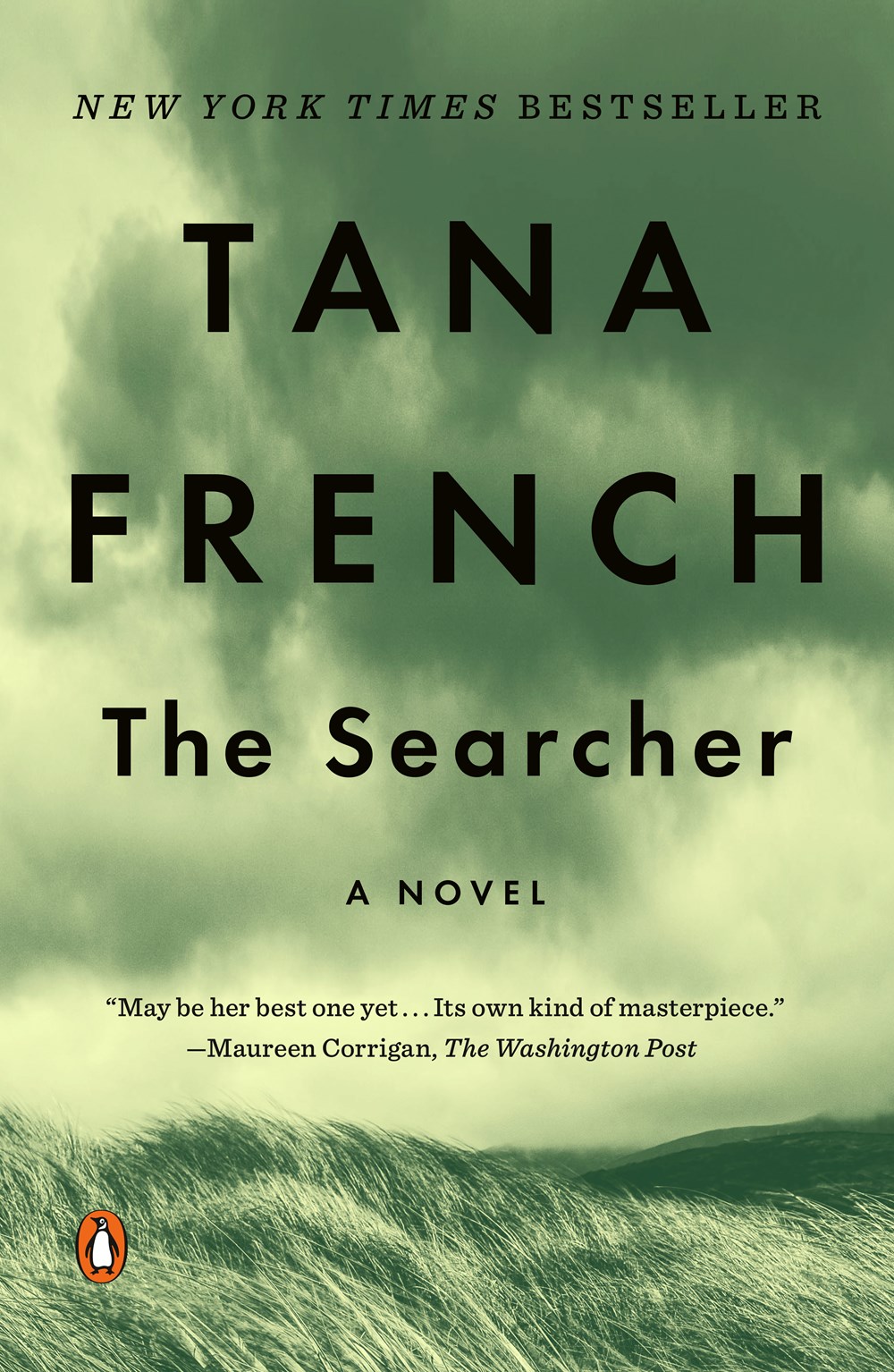
I read In the Woods by Tana French last year, my only other experience with French. Apparently, I have not yet reviewed it. (I have a couple dozen books on my backlist from 2025.) I read mysteries and crime thrillers largely because I’m forced to or they overlap with another genre, so I was happy when I was told that French was not only Irish, but her crime novels were “more literary” than the average. Well, they’re more literary than like 99% of them, though I would not call them literary, exactly. I’ll get around to reviewing In the Woods someday.
For now, I’ve just read The Searcher, which is the first in a series about Cal Hooper, a Chicagoan who relocates to a backwater Irish town after retiring as a cop and having nothing to lose. The next two are The Hunter and The Keeper, and since that last one only just came out, I’m wondering if she’s not continuing the series. I would read more about Cal, though I’m also content to leave it at this one. Like I said, crime isn’t really my jam. Sweeping, moody Irish stories, though: they are.
Blurb: Cal lands in a dilapidated cottage in the middle of nowhere, in a country he doesn’t belong, but he figures fixing the place up and lying low will help him put the cop life he had in Chicago and his divorce behind him. But then a boy shows up at his door asking for his help to find his missing brother. The local police aren’t helping, and the neighbors have something going on that at first seems quirky but then becomes rather menacing. But Cal didn’t want any trouble, did he? Can he just look the other way when justice isn’t being served?
Other people at the book club complained about it being slow for a crime-mystery. And atmospheric. For me, both were positives. The writing is not going to win a Pulitzer, but it is more than respectable. We’re really in Cal’s head, and everything lined up by the end. Then, with your friends, there’s quite a bit to talk about. French’s book series read like they would make great TV series, actually. The Dublin Murder Squad’s first two books became Dublin Murders, and I think the Cal Hooper books would also be great on the screen.
My one complaint is one that I had for In the Woods, as well. French tees the reader up real nice for just about anything, including something supernatural or religious (in both books). However, that specific tension is for naught, as she writes rather straightforward crime. I found myself let down both times that it didn’t skew a little weirder for the climax and the reveals. I might be just about alone for this. As for the other readers in my club, some of them didn’t like the ending or some twists, but then again, some people didn’t catch things they were supposed to. I thought it all worked together and made sense, and I felt satisfied (except for the regular-ness of it, as stated earlier).
I suppose if you want just another ol’ crime novel, you might wish French would cut it out with the brooding and the description. But if you tend to lean literary and want to read a crime novel, I think French is the one for you, including this book and In the Woods.
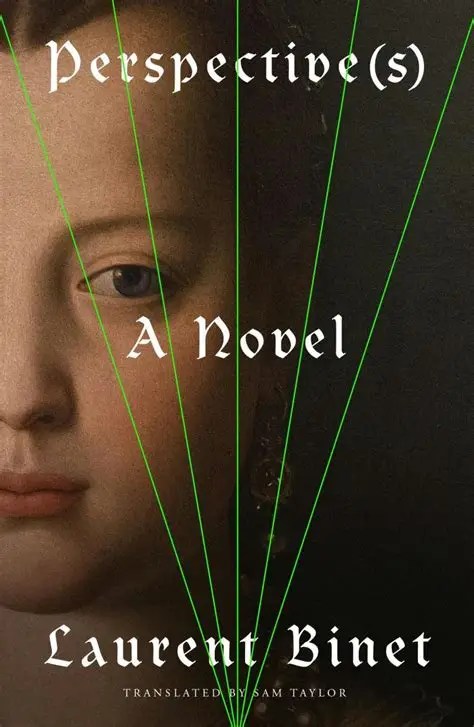
And now we’ve gone whole-hog literary with Perspective(s) by Larent Binet, even though it has been called a mystery. When I started this short, epistolary novel, I was not that interested. But by the end, I was riveted, and it felt like a dramatic montage that would make a great movie scene.
Blurb: An artist is found murdered at the base of his frescoe-in-progress. A lewd painting of the daughter of the Duke of Florence is discovered in a closet. Renaissance Italy’s arts and court scenes are thrown into a frenzy as everyone speculates and a fair few try to solve the murder and/or find the (now lost) painting. Careers and reputations are on the line. And could more intrigue lead to more murders?
So, most, maybe all, of these characters are real historical people (including Michaelangelo), and the story is presented like it’s a bunch of old found letters. But it is fiction. Juicy historical fiction. In fact, it’s juicy historical fiction that leads right up to Maggie O’Farrell’s The Marraige Portrait, so it would be interesting to read one and then the other. (I have already read The Marraige Portrait).
Here are all my thoughts:
- The character bios at the beginning was too much. You just have to let go and let God with this one. Just read and expect that the stories will come together, even if you don’t know who the heck is writing the current letter you’re reading. It does take time to warm up, but you just have to trust it.
- The build-up explanation about the letters being found, blah, blah, blah, was also too much for me. I didn’t need it. Could skip it. Plus it makes the beginning almost terminally slow.
- I did kinda skip the political bits. At least some of them.
- There were so many “Oh, damn” moments in this book. I love that.
- The word that hit my brain when I finished: “Brilliant.”
- I was laughing out loud.
- Everyone loved the nuns and Maria.
- I was really worked up at the beginning that a painting done without a woman’s knowledge would ruin her reputation. ?! Make it make sense.
HHhH is Binet’s other book. It gets better reviews than this one, which means I might like it even better. It is historical fiction about Nazi Germany, however, and I do struggle with fictionalizing history. Fictionalizing Renaissance Italy is one thing (since I know so little), but Nazi Germany? Apparently, it’s really interesting, though. (Clarification: I don’t have a problem with people writing fictionalized history as long as it’s clearly labeled; I just have a hard time separating fiction from fact once I’ve read it, in my own head.)
I would recommend Perspective(s) for people who like more experimental writing and literary stuff, especially historical literary stuff. It’s a short book, but you have to warm up to it and relax while you read: let it take you away to where you finally realize that it’s funny and tense and brilliant.
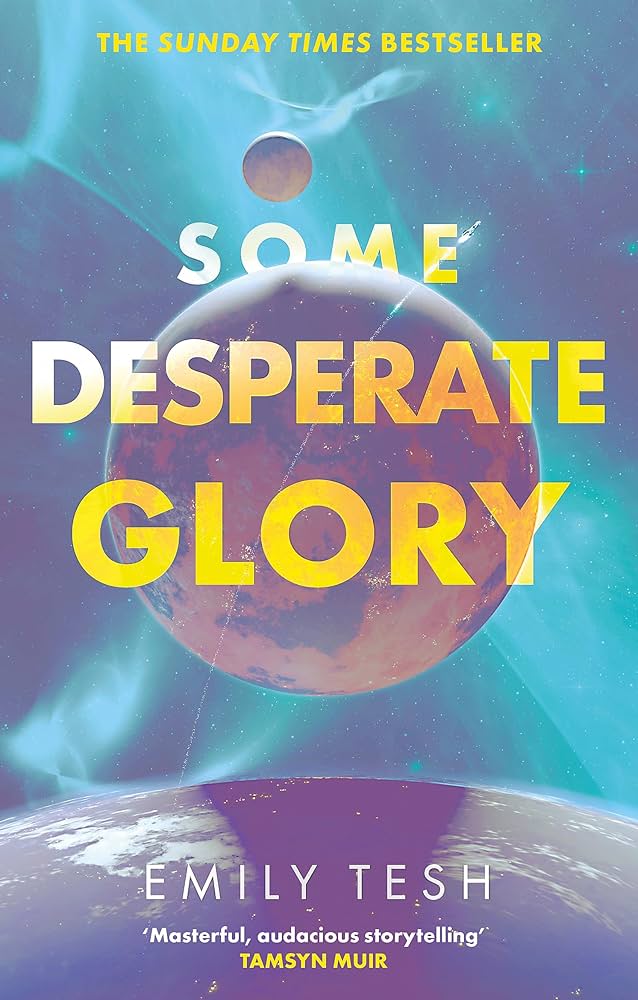
Looking at my notes for Some Desperate Glory by Emily Tesh is… daunting. While I read some books this month that I totally loved and appreciated, this wasn’t quite as shiny a read for me. And yet my notes are… extensive. I mean, I liked it. I did. And I totally plan on reading The Incandescent, Tesh’s newer book, which has way more buzz but a slightly lower rating on Goodreads.
Blurb: Kyr was bred and raised to avenge humanity from her rebel outpost on an abandoned space rock. She and her brother are the brightest and best, the colony’s shining hope. But when she gets her job assignment, and it sends her to the nursery to procreate and raise children, she is shocked into taking things into her own hands.
I’m just going to dive into the notes and say a bunch of things out of logical order.
I read the MC as both traumatized and autistic. Perhaps this is why I identified with her more than many of the other people in my book club. Some read her as a baddie? I saw victim. Survivor. I accepted that she had a couple early torture-the-kitten moments and expected her to mature and grow. That is a risky move, however, for an author to make, and it didn’t pay off for everyone. But how else do you read a member of a cult, except sympathetic, really? Everybody’s too hard on her. Also, she’s 17!
The pacing was different. The story kept sort of ending and then restarting (also resetting), like it could have been a trilogy (but how much do we appreciate just one book in a speculative story, amIright?). Lots of surprises, twists, and gear shifts, but always still the same genre.
It’s very ambitious, as a story. Or as one reader said, “It’s not perfect, but it tried a lot of stuff.” There is a lot of character growth. It’s action-packed (maybe too much, sometimes? Like there were no down-beats). Outer space. Queer normative society. Sure, they tell you it’s YA or new adult because of the age of the characters, but it’s not really a YA book. It reads as an adult book.
I understand how calling an alien they/them instead of it makes sense, but it was very confusing on the page, at times. I lost track of who they was, since there were other characters. Perhaps they could have edited for more clarity here.
The writing style is adequate. There is very little setting, description, or poetic writing, which I missed but plenty of people won’t.
Lots of complaints about the last few pages.
The title is from a poem. (For the record, I’m not a fan of the title.) “Dulce et Decorum Est” by Wilfred Owen. You probably read this one in school. It’s about a soldier who witnesses the horrific death of another soldier who doesn’t get their helmet on in time when they are gassed. The final lines are: “My friend, you would not tell with such high zest / To children ardent for some desperate glory, / The old Lie: Dulce et decorum est / Pro patria mori.” That last bit is a quote from Horace, and translates to: “It is sweet and fitting to die for one’s country” (Poetry Foundation, https://www.poetryfoundation.org/poems/46560/dulce-et-decorum-est, 8/31/2026). This all fits and makes sense, but I think she should have chosen a different title, put the poem as the epitaph. She probably did. It does underscore that Tesh has some things to say here. She’s not just writing fiction for entertainment’s sake. What does it mean to win a war? What’s it like to be on the wrong side? How is it the wrong side? And there’s trauma, etc.
Almost no one in the club agreed that it should have won the Hugo, especially over The Adventures of Amina Al-Sirafi, which we just read a couple months ago.
Other books to read, like it: Ender’s Game, Sun Eater, and Slaughterhouse Five.
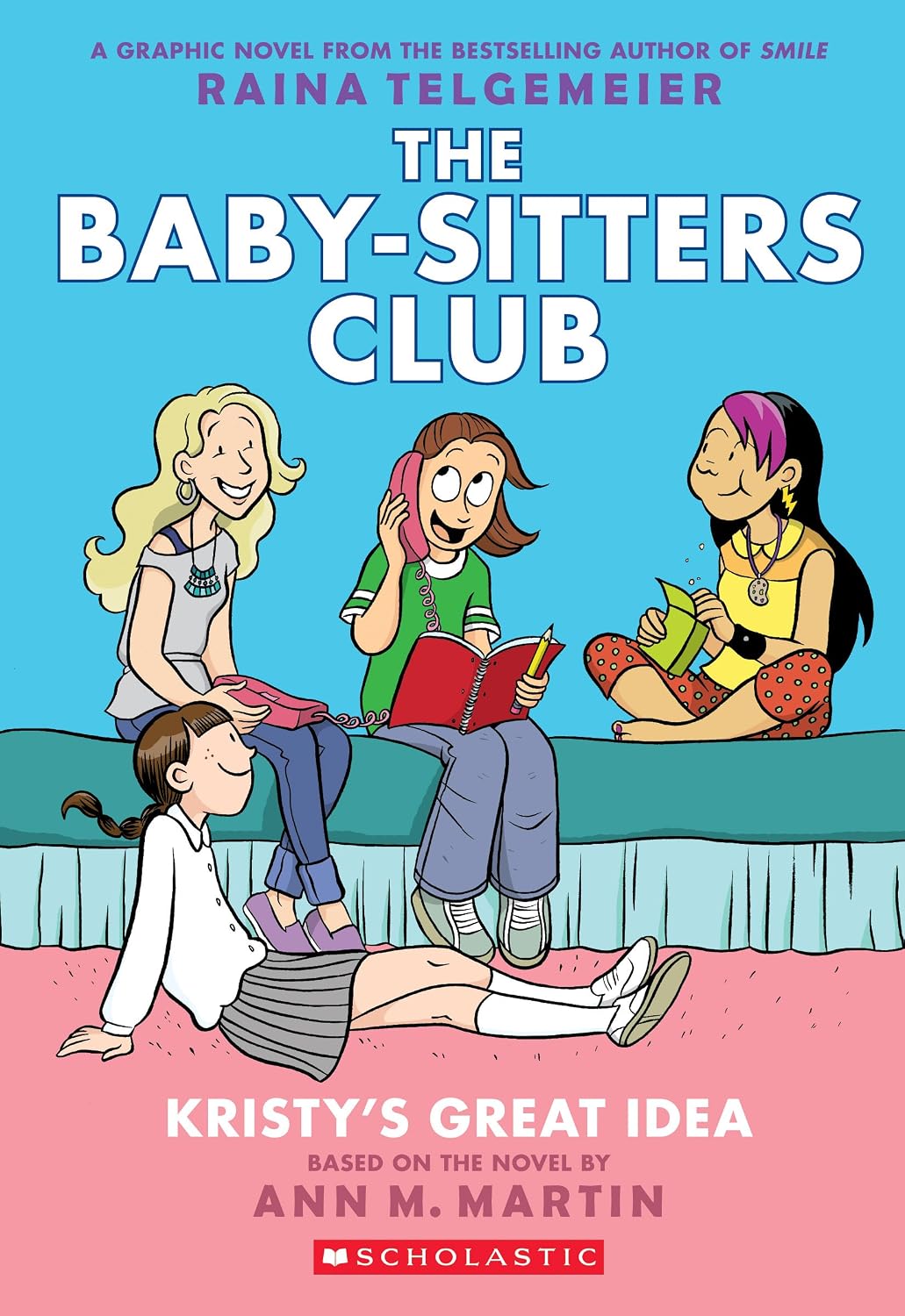
During the month of May, I also DNFed The Bone Witch and read (and reviewed elsewhere) The God of the Woods and There Are Rivers in the Sky. When I have a moment before I hit the next month’s book club and ARC reads, I slip in a light read or two (or even three. How fast can I go?). In May, I fit in only one, the first of the graphic novel version of The Baby-sitters Club, originally by Ann M. Martin. Raina Telgemeier adapted this novel. (Now that the graphic series is also popular, there are other authors who have taken on the adaptations.)
So, I was a huge fan of The Baby-sitters Club back in the day. Actually, you are about to get my bibliophile origin story. I was in elementary school, and my dad—an auto mechanic—would get home promptly at 5:30 every day. Very occasionally, he would arrive home with a little gift for me (and my siblings). One warm day, I met him at the door, and he handed me book one of The Baby-sitters Club, Kristy’s Great Idea, hot off the presses. I sat down on the porch and started reading. I didn’t get up until I had finished, the sun approaching the horizon. And I kept reading all the books in the series as they were published until I outgrew them—somewhere after the Mysteries and Super Specials lines had started and my little sister had started reading the Baby-Sitters Little Sister series (though she would go on to be a Sweet Valley High fan).
When a new generation discovered The Baby-sitters through a graphic novel by none other than Raina Telgemeier (I was already a fan of hers, too), I had to snag a few and put them on my shelf, intending to read them. And then they made a TV series. And then the graphic novels took off. How fun! (PS. I still keep my originals in a box in the basement. I just don’t want to part with them. Note: they’re probably too beat-up to be worth anything.)
Blurb: Kristy Thomas has a great idea: she and her two best friends form a club and share a schedule and advertising for a babysitting service. That way, at least one thing in her life is under control. But when Claudia invites a new girl into the club and that new girl clearly has secrets, how can Kristy just sit back and keep her mouth shut?
I had fun reading the graphic novel of Kristy’s Great Idea, as an adult. It was a nice, relaxing time for my brain, looking at art and taking it easy with low tension and a storyline I had watched unfold decades ago. There are some updates, obviously, to modernize the characters, setting, and issues. I noticed that even more with the show, which I watched a few episodes of before I got distracted away. But overall, there’s not that much different from the original first book. It—and the characters—all feel so familiar.
I don’t know what you could get out of this as an adult unless you were a superfan like me—maybe just a chill read. I will be reading at least a few more in the future when I need to turn off my critical brain. Otherwise, I would recommend them for the age group that they are intended, which is elementary into middle grades. They are clean and clear and cute and the plots, it turns out, are still relevant and interesting to kids. The Baby-sitters Club was never high-minded or academic, but I had a lot of fun with it when I was a kid, and now a whole new generation of kids is doing the same. That’s nice.
Next!


