April was not a great reading month for me. I guess we can understand why it’s taken me so long to review this gaggle of titles.

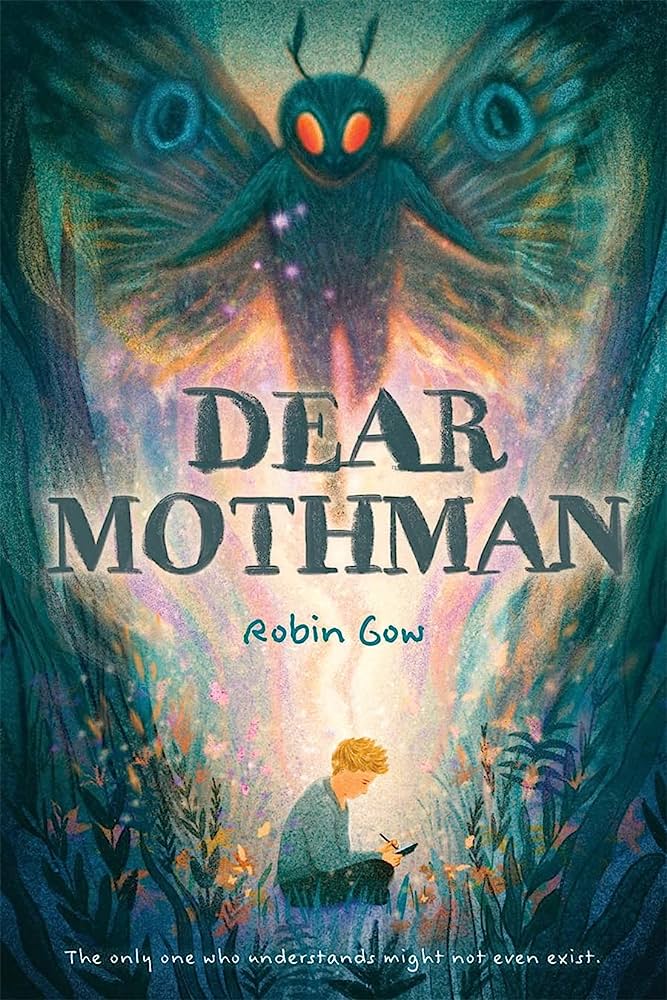
Dear Mothman by Robin Gow was on my radar before it showed up as a YA-for-Adults book club read. (For the record, it’s more Middle Grades.) This is partly because I have a moth-man of sorts in the book I just wrote, but also because I love a great MG read. With the whole novel-in-verse thing, I fully expected to like this one. And… I didn’t, really. (Note: I am in the minority of readers here. It’s at a whopping 4.23 on Goodreads.)
Blurb: Sixth grader Noah has just lost his best friend—the friend who was exploring their transgender identity with him. Alone in his secrets and his grief, he turns to his friend’s obsession with proving the identity of Mothman, a legendary cryptid from their neck of the woods. But which is more dangerous—stalking Mothman or making new friends who will see Noah for who he really is?
There is some charm to this book. There are some great ideas. But there is WAY too much going on. Let me just list out what’s going on on each page and you can decide for yourself if you can handle it:
- teeny tiny font size (which is especially strange for the age range intended)
- different fonts used for different chapters
- different paragraph alignment for different people
- verse (so not prose, meaning no paragraphs or traditional sentences, etc., except it’s not really verse at all, but we’ll talk about that in a bit)
- occasional illustrations (meant to look like a kid did them but highly stylized and not like any kid—even kid prodigy—I’ve ever seen)
- told in part in epistolary form, from a notebook and some letters
Ya’ll, that is about five too many gimmicks going on for my taste. I’m never a fan (maybe I shouldn’t say never) of tiny fonts or varying fonts. The alignment and epistolary could have worked for me, if it had been left at that. The poetry plain didn’t work for me at all. (It has in other books, like Inside Out & Back Again by Thanhha Lai. I have Lisa Fipp’s Starfish on the TBR shelf, as well.)
Why didn’t it work for me here, then? Because it wasn’t poetry. You can’t just break a paragraph down into separate lines and call it poetry. Any sixth-grade poetry unit will tell you that you need focus, rhythm, possible rhyme, and consideration of both sound (alliteration, consonance, onomatopoeia, etc.) and placement of words on the page. Dear Mothman was simply prose broken into short lines of “free verse.” Now, once I realized that, I just read it in my head like it was prose, and that worked better than trying to accept that it was verse. Other readers in the club who listened to the book didn’t have this problem, obviously. So, you could do that, but you would miss other things.
Like the illustrations. I did like them. They weren’t needed. And I didn’t buy that some kid had sketched them into their journal. They were cool, though.
Unfortunately for Mothman, too, I am currently sick of these books (especially for kids and YA) that are more like instruction manuals, like therapy instead of stories. We’re dealing with all this STUFF in society and hoisting giant decisions on kids, but we think lately that they can’t handle some actual tension and nuance in their reading? It’s like, too oddly gentle and straightforward. Noah says he loves metaphors. How about we stick to that, then? I would have loved some metaphorical struggles—more Mothman!—and less buddy therapy.
I agree with the critique that it is repetitive and slow, but my main issue is that it’s just way too much.
What did I even like about it? Huh. I know I liked things, but it’s hard to say what at this point. The idea. The characters. The suspense about Mothman.
Let’s just call it.
In short, I did not connect with this book, and I believe it was largely (but not exclusively) the fault of the physical book.
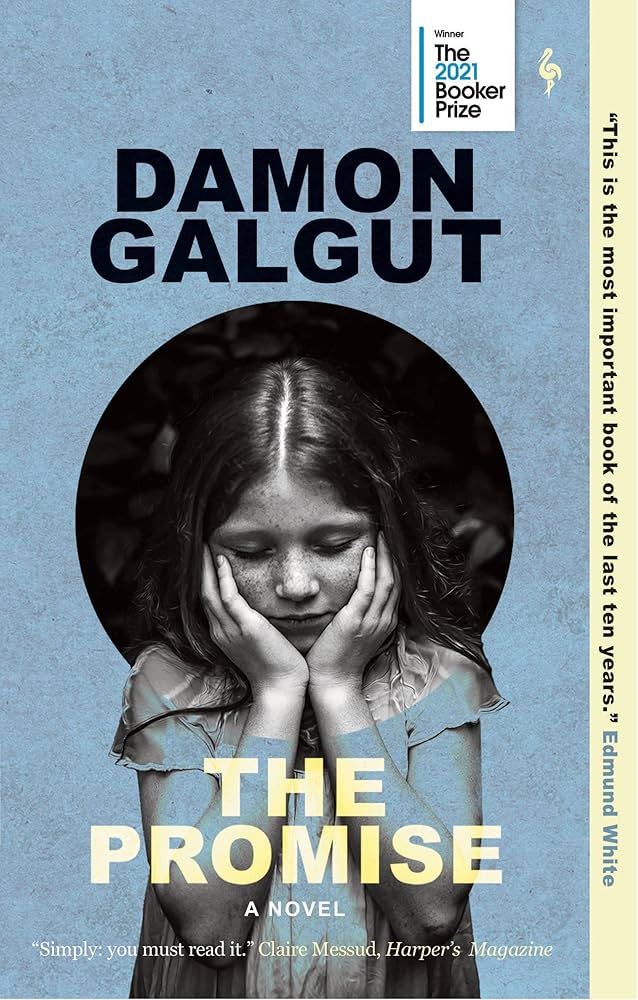
Right out of the gate with Damon Galgut’s The Promise, I was amazed by the writing. Sure, it takes concentration to begin, but I’m okay with that—I can work for my high-level (Booker-Prize-winning) reading experience. I also noticed right away, however, that I hate these characters and it’s harder to be in this setting with them. Somehow, I am even almost hating a 13-year-old girl who has just lost her mom. Yikes.
Blurb: A teen girl’s mother dies, but not before extracting a promise from her husband that he will give Salome—a Black woman working on their South African farm—ownership of the house she lives in. But that’s not what happens, and the daughter watches from a position of helplessness as her family keeps from Salome what should be hers. And as the decades go by, the children of the farm grow up and people die and still the promise sits, unanswered.
FYI: There are no chapter breaks, and we all should know by now how I feel about that. Okay, maybe you don’t and that’s okay, but I have complained about writers not using chapters many times lately. The chapter breaks help readers read books. Deal with it! There are, however, four sections and finally a book with section breaks that make sense. (I have read a lot of books lately with pointless section breaks). There are no quotation marks (which is how they do it in some places, I guess).
There is also a shifting POV (like sometimes paragraph-to-paragraph) including 2nd person, which may sound like I’m complaining, but Galgut actually uses these things in creative and interesting ways, and I’m able to get past the lack of quotation marks (and almost past the lack of chapter breaks). I mean, I love the slippery nature of the narration, the almost magical elements to the perspective and the lack of barrier between this life and the next. There’s not an enormous plot, but I just cozied down into the exciting and beautiful use of language. And with the history of South Africa and Apartheid playing out in this family (yes, of characters you don’t actually like), there is plenty think about as you read and talk about later.
Overall, I found The Promise to be an excellent read, but not a night out with buddies. Just as it should be. I felt right away that I was in capable, writerly hands. Galgut knows what he’s doing, and sometimes it’s pretty radical.
More FYI: South African (and Jewish) vocab abounds. Slipslops (flipflops), hooter (horn)…
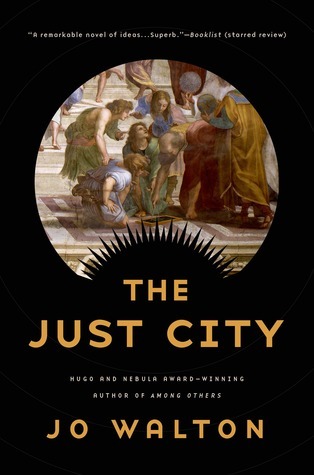
It is difficult for me to put into words the way I feel about The Just City (Thessaly #1) by Jo Walton, or my experience of it. Especially since I had to miss book club, where I could have listened to other people love and hate it. But I will do my best.
Blurb: Athene loops Apollo into an experiment that she has concocted, where she’ll pull the island of Atlantis out of time and populate it with admirers of Plato’s in order to attempt the great social experiment of the Platonic Just City. Bright minds and noble characters—included Socrates—begin with a few hundred orphans, orphans who will be trained to raise the first generation of children born into utopia. Apollo opts to join them as an anonymous human with human limitations, and his first lesson is that not every bestie comes wrapped like a beauty queen.
I’m gonna just write it out.
It’s too sterile. Despite my being intrigued by the ideas and the philosophy (my bachelor’s is in philosophy) there are way too many long dialogues and characters thinking and forming a city to make this book work as a story, as a piece of coherent fiction. When a plot occasionally arrives. the sudden action felt out of place, rushed. I lamented that it could have been told much differently. Way back when I read the first chapter, which has the gods’ setup, there was a lot of showing and some really impressive writing and I thought I was in for a great read. But then that faded away into a strange reserve, a removedness that makes even rape and sex scenes oddly sterile. (Quite a few people have problems with the rape scene(s) in this book especially, and I think this is largely why.)
Okay, so maybe the sterility and all the ideas words are because we’re building a Platonic ideal city, and we’re dealing with philosophers and even budding philosophers as POV characters. But they’re not automatons. They have feelings! And the world around them isn’t just removed objects. And speaking of robots, the robot sentience themes were out of place for me. I could have done without it completely, though I understand it was driving home the point that the humans were also human and so any city with them was going to end up messy and imperfect or whatever. But Walton could have set this up with the actual people. As for the robots, hit us over the head, why don’t you? And the arguments for their “souls” were poor. Come on, Socrates (whom I liked as a character).
But I also kinda couldn’t put the book down. There were such interesting moments. And I still wanted the writing from the beginning to return. So, I made it through and was all ready to chat about it with my friends… until I had to miss book club. Guess we’ll never know what they all thought. I do know that my book club bestie loves this book—this trilogy—and, in fact, recommended it for the club. There is something there for a certain type of reader, and I was almost there but never quite (after the first) comfortable inside the writing style or story’s structure.
Would I go on and read the second and third in the seriies? I’m not sure. I’m giving it some space. My initial response would be no, I don’t need to. But I bought the trilogy in one volume, so it’ll be there if I ever want to return to this story and these characters.
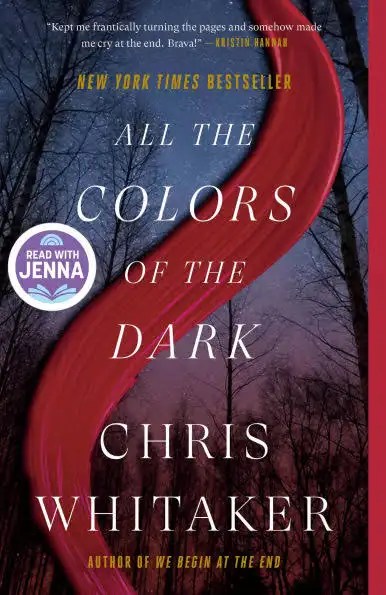
Yikes. I know this is not the most popular opinion, but All the Colors of the Dark by Chris Whitaker was a big fat DNF at almost half-way for me. It did take me a while to figure that out, probably because I kept second-guessing my opinions based on the enthusiastic accolades of other readers. Also, maybe because I was listening to most of it (just to make sure I could fit the whole book in (600 pages!) in a month with a couple of other large books and no less than seven book club reads). The audiobook narrator left much to be desired. That might also be an unpopular opinion, I don’t know, but his voices for the characters flavored them in weird directions that didn’t seem like what was there in the text. For example, there were a lot of whiny moments. (Overall, I just wasn’t a big fan of the audio narration, so I read some on the page just to see… That did not really improve matters.)
Let’s complain now.
I found the characters to be inconsistent. And after all that, a little flat because of it.
The writing style was all flowery, sure, but sometimes really not right. Like literally, words were frequently misused, and phrases cropped up that didn’t actually make sense (but they kinda sounded cool).
Narrative beats repeated, and not in a good way. (Like two subplots where a main character was looking really hard for another character, two main characters saving another main character’s life, etc.)
The MCs were almost all insanely obsessive to the point that they became 100% self-absorbed and were so cruel to everyone (even their besties and families) around them. Like someone in a review said, “Does Whitaker know how people actually think and behave, what they are actually like?”
All the Colors reads realistic (you know, fiction that makes sense in our world), except there were so many weird coincidences. And just plain weirdly unbelievable or nonsensical things. When I got to the point where a main character is painting the portrait of a girl he had never seen so that the PD could use it as missing persons flyers, I finally switched gears in my brain to, “No thanks.” That moment was the straw that broke the camel’s back, a couple-few hundred pages in.
I’m sorry if you’re one of the many fans of this book, but I found that it didn’t live up even to its supposed bright points. I really didn’t enjoy it at all after the first several chapters and had to shut it down before I argued myself silly (with the audiobook narrator, in the car). Not a recommend, despite the fact that so many other people would read it and enjoy it. I can’t help but feel like they’re being tricked with this one.
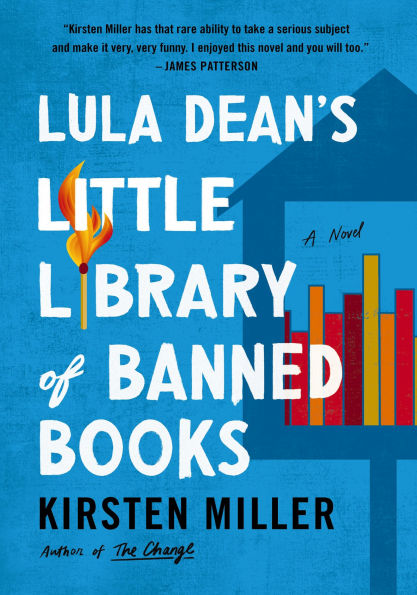
Nope. Just nope. I DNFed Lula Dean’s Little Library of Banned Books by Kirsten Miller after six short chapters, which I realize is an invitation for bullying from the far left, but I DNFed it because of its merit as a book and also its utter lack of nuance and empathy, not because I can’t handle some anti-book banning. (If I accused The Just City of sledge-hammering, it’s nothing—nothing!—compared to this one.) I am anti-book banning. Lula now sits in my DNF Graveyard, so you can see it there if you would like.


