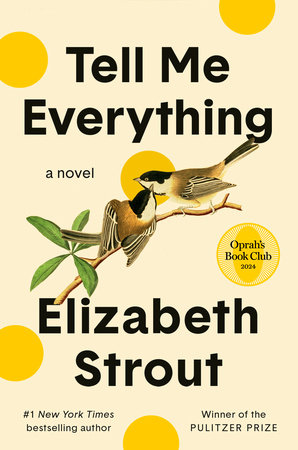
I fully expected to like Tell Me Everything by Elizabeth Strout. I expected it to be an easy read. It would have been an easy read, except I was pretty bored (so it was difficult to want to pick it back up). I liked (and more-so respected) Olive Kitteridge back in the day. And then this. I don’t think I need to read any more Strout unless her magnum opus is yet to come, and the world tells me it has arrived. Likely, Kitteridge was her magnum opus.
Blurb: Oh, Bob. Bob Burgess (of The Burgess Boys) is comfortable enough in his life, his semi-retired job, his second wife, the small town in Maine he returned to after the excitement of New York City. What brings him the most satisfaction, however, is his walks with Lucy Barton (of My Name Is Lucy Barton). As he takes on the defense of a local man accused of murder, is it possible that he’s falling for Lucy? But he’s such a nice guy! (Olive Kitteridge (of Olive Kitteridge) also makes some appearances).
Officially, Tell Me Everything is the fifth book in the Amgash series, the tenth book in the Strout universe that is related to ol’ Olive and her small town and Lucy and her small town (which come together by Tell Me Everything). It would make sense to read these books in some sort of order so that the reader understands all the connections and references. I was assured that I could read this book as a standalone, and that was true. However, if you are fond of Strout’s writing, it would make sense to read all the other books first. The order of publication (and as far as I can tell the best order to read them in) is:
- Amy and Isabelle
- Abide with Me
- Olive Kitteridge (Olive #1)
- The Burgess Boys
- My Name is Lucy Barton (Amgash #1)
- Anything Is Possible (Amgash #2))
- Olive, Again (Olive #2)
- Oh William! (Amgash #3)
- Lucy by the Sea (Amgash #4)
- Tell Me Everything (Amgas #5)
I had planned to read My Name Is Lucy Barton before Tell Me Everything, that way I would know the character of Lucy Barton, at least. In hindsight, The Burgess Boys would also have been helpful. But I ran out of time to read Lucy and ended up returning it after I finished Everything. Because I think I’m just not a Strout fan. But don’t let that deter you necessarily. Strout has many, many fans. She also has awards. And Everything was called the best book of the year by more than one publication.
Nevertheless, here are my impressions of the book.
If I had to read “Oh, Bob,” (or “Oh, some other character”) one more time… Overall, I found the conversation insipid and unrealistic with how much they said each other’s names, etc. (Strout should have titled this one Oh Bob!, a play on Oh William!.) I don’t have to have a conventional plot to enjoy a read, though I do find them desirable. I was bored with Everything‘s lack of plot. There was an interesting story there, a murder mystery, but the story was told only in between the exciting bits. Like when other characters were sitting around talking about it. Or driving there. I think this is intentional, and seems to be Strout’s style. While it worked somewhat for me in Kitteridge, I was both annoyed and bored by it this time. For one, Olive Kitteridge is a much more interesting character. Two? Maybe this setup only worked for me once. Three, Everything lacked the weight of Kitteridge, and while the Maine weather and nature were there again, it felt glazed over and tacked on. Also, how many marriages can one small group of people have? I personally don’t take marriage that lightly.
I know many readers gush about Strout’s writing style, but I didn’t think her writing was that amazing. To return to the story, too, it was definitely repetitive. The dialogue tags felt juvenile, sometimes confusing. I’ve said it before about books, and I’ll say it about this one: it felt like an early draft, a collection of possible scenes that weren’t quite polished and didn’t make a whole. Some scenes just needed to inform Strout and then be chucked, quite frankly. And the characters here, it just plain isn’t my life. I don’t mean that in the particulars, because I love to go into a character and a setting that is completely other. What I mean is that the point of the book, the internal world of these people, was so alien to me that I wasn’t relating to them. Where was their North Star? Thier compass? I was flailing for connection, as a reader.
The ending almost made it worth it for me, but I don’t need to read Strout again, thanks. And maybe it’s not all her fault: most popular fiction/women’s fiction/book club fiction has been falling flat for me lately. I have started to say I like literary fiction and genre fiction, but not the stuff in the middle. Sure, Strout’s stuff is considered literary, but it didn’t feel that way to me. Very light literary, at the most.
Which sounds like I have nothing good to say. I kinda don’t. It was tolerable. I made it through. I was not impressed, though, and would have preferred just hanging with Olive in her room and with the suspected murderer in his house, which was the opposite of what this book did. (I mean, Olive didn’t even actually belong in the book, but I can see why Strout would loop her in.)
So long, Strout. Here’s to a long and successful career (which you already have). I kinda don’t get what all the lovers saw in this book, but I will leave you and everyone else to it.


 the starving artist