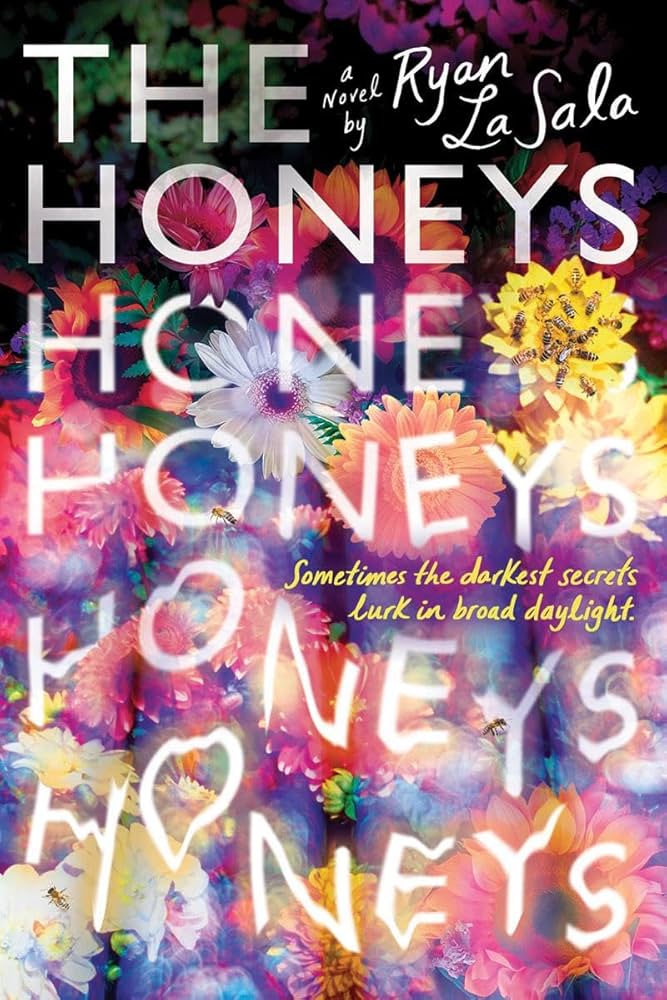
I was a little scared of The Honeys by Ryan La Sala because of the horror thing, even if it is YA. Honestly, many teens in my life can handle way more jump scares and gore than I can. Or they think they can and therefore watch and read it. But this book was full of camp (pun intended) and I do better with campy horror than, I dunno, some serious occult stuff. It was also full of heart, for horror anyway. Overall, this book seemed pretty close to what it should be, which turned out to be like Bunny for the YA crowd.
I wanted to take a moment to address the elephant in the reading world right now. Though many of us have crashed into the summer with summer-camp-themed reads in hand, it would be tone-deaf not to acknowledge that suddenly titles like God of the Woods feel different after the events of the past week. For those of you reading this post in the future, I am referring to the flooding in Texas and specifically of Camp Mystic. As I write this, there are 119 dead from the flooding and 160 still missing. Many of them were campers and workers at Camp Mystic. I would hope that in the future most of us will think again of summer camps as not only great story settings and fodder but also as magical places full of fun times, secluded friendships, nature, and memories. But right now… it’s tragic what has happened, and we mourn as a community. If this tragedy is affecting you in a way that you can’t read summer camp literature right now, that’s totally fine. I would skip this review, and this book, for now.
Synopsis: When Mars’ twin sister returns in the middle of the night from a prestigious summer camp only to die unexpectedly, he has so many questions about what was going on at that camp. The camp that rejected him as a gender-fluid kid. The camp that Caroline had continued to attend, rising in popularity until she became an elite Honey. With Caroline’s spot left vacant at camp, Mars decides to fill it, if only to figure out what really happened to his beloved sister, but the thing most frightening may just be the archaic gender norms. That, or the bullies, or the trees with the all-seeing eyes.
Note: the format on the page is horrible. My paperback copy has the text too close to the spine so that I have to pull as far as I can and peer into the crack. Also, the large writing and roomy spacing makes it feel like I’m reading a kids’ book.
Okay, so I had just read Bunny by Mona Awad. It was a coincidence that these lined up. I read Bunny before an event and The Honeys with one of my book clubs. But they had some similarities of tone, genre, themes, etc., that made it an uncanny pairing. Then again, Bunny has some layers and is meant for new adult, at least. The Honeys is straight-up YA horror. But even their names… And the meaning of the names. “Bunny” is what a group of close-knit, little-bit-off girls call themselves and “the Honeys” is what… oh, it’s exactly the same. For what it’s worth, Bunny is older. But they don’t feel copied, they feel like a product of their time and generation. Julie Chan Is Dead also has similar vibes and that same group of close-knit, little-bit-off girls and the campy horror thing.
Besides that, queer horror is such a thing right now. This book is very YA and quite queer.
I found the writing style in The Honeys to be above average. Where some people at club called it “overdone” or “florid,” I thought the descriptiveness was nice, the word-play refreshing for YA. It was still easy to read (except close to the spine) and I was interested in Mars and the plot all the way through. (Okay, maybe occasionally I got a little lost, especially with background characters.) Though I was kinda let down by the ending, it was just what a horror novel should be (so it was a me-problem) and I also thought the way Mars’ queerness was dealt with in the climax and resolution was satisfying, touching. And also who ends up being the villan(s). And who doesn’t.
Let me just say this and get it off my chest: not all speculative fiction has to justify itself. As long as the world is consistent within itself, science and reality be darned! I don’t want you to look for scientific explanations in this book because that would be silly. It’s creepy and supernatural at times and it’s not only fictional but fantastical. By definition of the genre.
It’s no secret that La Sala wrote this book out of his own gender-fluidity and also to deal with the death of his own sister by brain cancer.
There is only one thing that didn’t work for me in this campy, queer, girl-power, book, and that was the mind wipes in the first-person perspective. Sometimes we would go through a whole scene and then Mars would lose his memory of it, but as a reader I would still know what I just read, so the first-person perspective was really rooted to time, and I found it… weird. Not good-weird. I actually don’t know if I hated it, exactly, but it felt like cheating. If I’m in Mars’ head, I should only know what Mars knows at any given point. I found that whole part of it awkward. (Oh, I also thought dividing the text into parts was superfluous and should have been done away with. The melting chapter headings… great.)
The truth is that this book wasn’t meant for me. There is YA (and even Middle Grades and children’s writing) that is universal. Then there is literature that is targeted much more strongly so that its audience is narrow, by age. The Honeys is quite strongly a YA novel and it felt like it wasn’t meant for me, so much. (I have felt this more with some other books, though.) Even so, I appreciated it. If you’re a teen who reads horror and wants themes of queerness, girl-cliques, and summer camp, then you should try this out. It doesn’t have the highest ratings, but our club (of adults) liked it more than disliked it (about two to one).
I have heard that the audiobook is a no.
La Sala has another book coming out in September, The Dead of Summer.
His previous books are:
- Reverie
- Be Dazzled
- Beholder
It appears that his books are all horror (or at least creepy fantasy), feature LGBTQ+ characters and themes, and often bugs. I take that back. Be Dazzled is romance, not horror.
“Death isn’t the end of life, but the division of it” (p7).
“My sister becomes a constellation of voids” (p8).
“I’m not like her—I catch on everything. Every small want grows out of me like thorns, making me impossible to embrace” (p24).
“…grief, I have learned, cracks us into pieces that make all sorts of strange, alarming shapes…” (p51).
“There’s nothing after, neither bright nor dark. No disorganized energy or dissipated particles. That’s what I tell myself. Anything more than nothing leaves too many questions. Conditions and bargains I can’t deal with. There must be nothing. I need to know that there is nowhere left to look, otherwise I’ll never stop looking” (p133).
“I mean every word but all I hear are the flat apologies of the people who tried to comfort me. I wonder if maybe I heard them wrong” (p139).
“It’s fucking funny. Clout like that is fragile. Masculinity is, too, I guess” (p163).
“Her smile is so big it somehow shows up on my face” (p176).
“Contentedness is a party I leave early every time” (p214).
“I know what survivors of all kinds know. When there’s a real threat, you cannot waste time denying it if you intend to live through it” (p266).

There was news in 2023 that The Honeys was being adapted into a movie with La Sala as one of the people working on the film. I have seen nothing since, so that may mean the project is stalled indefinitely (which happens to oh so many films). Or not. We’ll see.


 the starving artist
Thank you for such a comprehensive review. Had I not found you and read this review, I most certainly would not have given it a read. Now I will.