I have not had this much fun reading a book(s) in a long time. And it’s not like I haven’t had some fun reading some books lately, it’s just that the Love’s Academic series by India Holton is the most fun. Victorian England, fantasy, science, romance, and Indiana Jones, but over-the-top on all counts. I thought I might enjoy it, but I loved it. I won’t be able to read her other stuff fast enough.


I picked up the second book in the series, The Geographer’s Map to Romance, as an ARC of sorts. Sometimes ARCs (advanced reader copies) are really just brand-new copies sent to bookshops and book influencers, not actually in advance or different from the book everyone else is getting on the shelves, you know, for promotional reasons. I picked it up a little in advance, but just got to reading it, well, yesterday. It was published on April 8th, a couple weeks ago. Which means you can run out and buy the first two books right away! Since I had been given a copy of the second book, I went ahead and purchased a copy of the first book and read that first. Then devoured them both.
Those books are The Ornithologist’s Field Guide to Love and The Geographer’s Map to Romance. The projected next book in the series is The Antiquarian’s Object of Desire. I have not seen a projected date for that, but I’d say give it at least a year. In the meantime, I am going to pick up Holton’s other series, Dangerous Damsels.
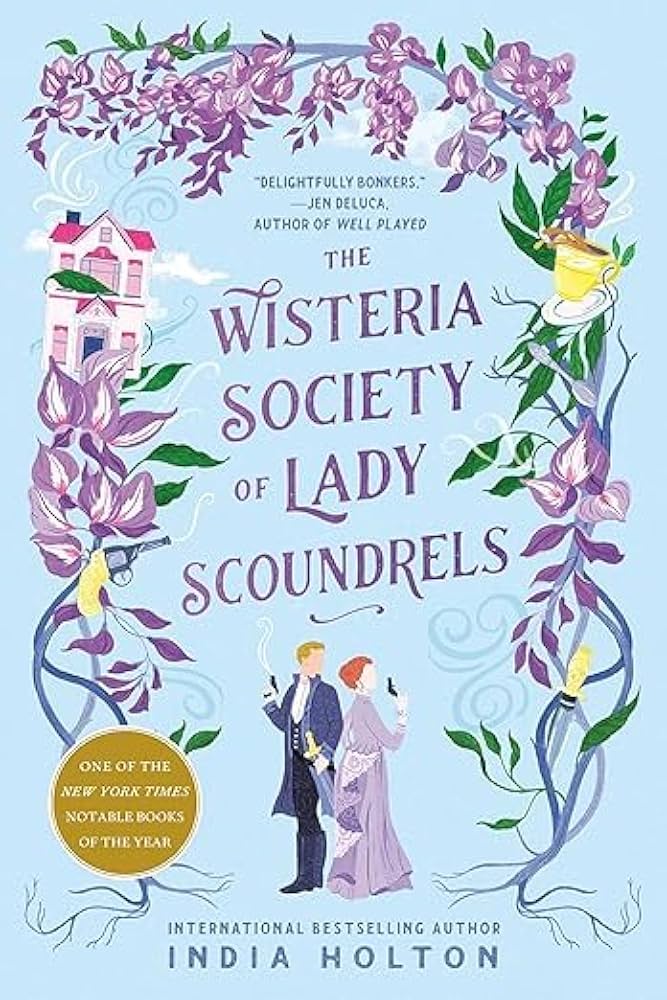
The thing is, you can read any book from the Love’s Academic series in any order you want. They are episodic, and even though there are connections from one book to the next with background characters and even references to previous plot points, there is no need to know them. They’re more just for fun. And each story has a different heroine and hero, though so far, the tone and the voice are very consistent. Both books are a wild romp with witty moments, pervasive humor, literary references galore, steamy romance, Victorian British muddles, word-play, feminist fun, light steam punk, magic mixed with science, coziest cozy, entertaining side characters, and seriously over-the-top conventions to the point that we’re satirizing them. No, maybe it’s farce. Or just reveling in tropes. All of it. Like I said, the most fun. Or like Jen Deluca says on the cover of The Wisteria Society of Lady Scoundrels, “delightfully bonkers.”
I started with book one, The Ornithologist’s Field Guide to Love. It is (surprise!) about two thaumaturgic ornithologists/professors dealing with magical birds. There is a competition for Birder of the Year which will come with ***tenure!*** and Beth Pickering wants that prize. But not only has it turned all the other already-ruthless birders into enemies, the rather attractive and villainous Devon Lockley has joined in the chase. Proper and roguish are natural enemies, aren’t they?
Yes, we know where this is going. Genre fiction isn’t meant to surprise us in that way. We know what kind of ending is coming. We know that there will be delaying and longing and moments of sizzle along the way. But, believe me, you are still going to come across surprise after surprise, delight after delight, in the plot but mostly in the writing style. I did find some mistakes here and there (mostly typos), but I trust Holton. She means to do exactly what she is doing. She could write literary fiction if she wanted (that’s my take), but she has given herself to our entertainment and secreting book-lovers tidbits and adventure-fantasy nuggets in between writing that is far better than adequate (which is my threshold for a genre book). You might now and again think she’s gone too far, that she’s off the rails with her writing or just in imagination, or that it’s too cutesy to use strikethrough font, but you’d be wrong. She’s gone and done (and said) exactly what she meant to. She’s given her talents to not only genre and cross-genre but also to our good times while also hiding a million little edifications of a sort (or skillful lunges with the literary rapier), and she has excelled.
I’m probably talking it up too much. And surely there are people who just won’t enjoy this style, what she’s trying to accomplish here. But I am so on board. I am in the fan club and first in line! I am unapologetic.
And then I got to the ARC, The Geographer’s Map to Love. And I loved it even more than the first one! For several little reasons, I found it to be constructed better. But I was thrown back into this wild world of my dreams. Whereas Ornithologist was very Indiana Jones-ish, Geographer was constantly referencing literature, including Shakespeare and Jane Austen. It would be hard to narrow down the influences in these books, really, but the mish-mash is a perfectly overlapped Venn Diagram with my dream world. I loved Indiana Jones as a kid (and still kinda do), Shakespeare, Jane Austen, and all the other crazy things thrown into the mix.
One thing: reading both books that close together was probably not the best idea. They are pretty darn similar, being comedies-of-errors, opposites-attract stories between young, savant science professors in the same fantastical world. With two braided perspectives, leaning more heavily on the female. With fake-quote witticisms opening each chapter. Even the same catch phrases, including “gosh” and “Aaaaaggghh!” Therefore, a little space would have taken away the “Did I just read this?” feeling. However, I didn’t stop. I couldn’t if you offered me tenure.
Elodie Tarrant married Gabriel Tarrant at a moment’s notice as a marriage of convenience. But the Doctors Tarrants’ avoidance of each other a year later is anything but convenient. When a thaumaturgic geological disaster looms over a small town in Wales, nobody is sure just which Doctor Tarrant is being called for and so they both board the crazy train for the Welsh countryside. Gabriel is arrogant and stoic (which can actually read as autistic in a different time and culture) and Elodie is the freest of free spirits (which can read as ADHD in a different time and culture). Which means that they can’t possibly fit together, right?
Goodness. I was laughing out loud and underlining poignant life lessons throughout. I happened to have an actual day off yesterday and since I had enjoyed Ornithologist so much, I picked up Geographer. I finished it before bedtime. Sure, if I had had things to do that were pressing on me, I would have had to set the book down and take a couple days, but I probably would have missed much sleep because I couldn’t put it down.
You get it. I love this series. I will be reading more of the series when it drops and also more Holton. I know some people won’t click with it, but many will. Just relax a little and let Holton take you on the wild historical-adventure-fantasy-romance ride that is the Love’s Academic series.
The Ornithologist’s Field Guide to Love
“A wise woman allows nothing to ruffle her feathers; she is the ruffler of feathers” (p42).
“The adventuring woman should not just expect the unexpected, bu be the unexpected” (p258).
“’Good grief,’ she muttered. ‘Why do people have to people?’” (p269).
“And anyone who says cruel things, or uses silence as a weapon, is a bully who knows how to be violent without lifting a finger” (p283).
The Geographer’s Map to Romance
“Elodie didn’t mind, feeling that tedium was best described as an opportunity for imagination” (p4).
“If you want things to flow easily, you have to give a dam” (p17).
“Manners are for people who don’t have anything more interesting to say” (p21).
“Longitude tells you your relative position, much the same as longing does” (p89).
“Time doesn’t only go forward, it foes deep too” (p125).
“Sometimes place is a feeling” (p159).
“Pull yourself together, Elodie Hughes, she grumbled, or her mother did (sometimes it was hard to tell the difference between those two inner voices)” (p165).
“What we see of a tree is its own underneath. Dirt is its sky, and light its dreaming” (p221).
“…the tetchiness she knew so well, and that’s she’d even come to love, recognizing it to be not a meanness in his character but a vulnerability showing where he was rubbed sore by a world too loud, bright, and rough-edged for him” (p244).
“…she appeared to be efficiency personified, a trait all too often equated with ‘terrorizing’ in women” (p282).
“Oh God, this was why she shouldn’t be left unsupervised with a conversation!” (p305).
“You’re already where you want to go. Getting there is part of being there” (p308).

There doesn’t seem to be anything in the making from Holton’s books. But honestly, while I think the Love’s Academic series books so far would make amazing movies, I also don’t think they could be quite what the books are—they would have to lose some of their dimension since the word-play and literary allusions, etc., are a large part of the art.


 the starving artist