
I like Little Women by Louisa May Alcott. It’s a great classic and in many ways, it is right up my alley: gentle, warm, deep, encouraging, historical, full of three-dimensional characters and relationships, and challenging ideas. It is a little vignette-y for me, but I forgive it because it feels right for the time and it does eventually pay off with some through-story-lines. It also lacks the kind of description I enjoy, but the straight-forward, unobtrusive language helps to usher the reader into the setting, anyhow.
I am fond of reading the classics, if you can’t tell. I’m also fond of reading the new, literary stuff, actually, but old titles weigh more heavily on my conscience because I haven’t read them yet even though they’ve been around for fifty, a hundred, even a thousand years. I have actually read Little Women twice before: first as a tween and then as a young woman with a limited library and no children (therefore some free time). Both these readings happened before The Starving Artist, so I wanted to return to reading Little Women for a review and since it came up on the Christmas reading list, I thought it was time. (FYI, it is not a Christmas book and I wouldn’t recommend it as such. There is only one main scene that takes place on Christmas, though you could read that part at Christmastime…) I remember liking the book before, though I would imagine most modern readers do not read this work outside of a vacuum: with the two popular movie adaptations plus any other number of adaptations. This was me, too. I have seen both the 1994 and 2019 versions more than once each because I like them for themselves. But in every version I had always felt disappointed at the end of the story. Perhaps not anymore? There is a meta sense to this thing that Greta Gerwig (2019) brought attention to and, well, I am also older and see things in the text I didn’t want to see before. It’s a classic and remains a classic and I enjoyed reading it and found so much history, comfort, even wisdom in it.
Jo March is the second-oldest of four sisters in Civil War Massachusetts. Her father is gone to war and her household, with the patient, loving, indomitable Marmee at the helm, is struggling with poverty, courage, compassion, and what it means to come of age in a society skewed toward men’s empowerment and fulfillment. The sisters each have distinct personalities: Meg, the eldest, is sweet and expected, while also being tempted by ribbons and bows and wealth; Jo is tempestuous and ambitious and feels much more at home with the boys and doing “boyish” things; Beth is docile and angelic, a paragon of domesticity; Amy is immature (as the youngest, partly) and girly, determinedly refined and pragmatic. Into the mansion next door moves an isolated young man with his crotchety grandfather. Woven with the friendships, romances, and family vignettes are the struggles of each girl to grow into the “little women” that they hope Father will find when he finally comes home. Meg meets a man. Jo rages against the world. Beth becomes frail. Amy has the grandest plans of all. And always, there is Laurie.
It’s hard to know where to start here, because there is a lot to say about this book. Let’s do this first: this is not actually one novel. Most copies in the United States are sold as just one bound book, titled Little Women, but it’s actually two books in one: Little Women and Good Wives. In my old, battered, Watermill Classics trade paperback, these books are separated with markers that read “Part I” and “Part II.” There is no acknowledgement, really, that there are two books there. But officially, if you make your way through that big ol’ copy of Little Women, you are two books closer to your annual reading goal, not one. Officially, Little Women ends with the shadow of Meg growing up and entering into an understanding with a young man. Good Wives picks up three years later and concentrates on the four sisters (and Laurie) figuring out their lives and entering into partnerships. Together, both these books make the story that we think of (and that the movies portray) with its overarching story of Jo’s and Laurie’s relationship—left hanging in between books—but they are also very distinct. The first is an innocent tale about children full of domestic doings and tough lessons, while the second is full of separation and big choices, increasing the epistolary approach because characters are literally separated for large sections.
And let’s address that I said “its overarching story of Jo’s and Laurie’s relationship.” I did say it. Head on. The biggest problem people have with this book is also intimately tied to the author and her relationship with these books, her world, and her publisher. Is the book about Jo and Laurie, at all? Let’s talk about that, because I think that most people would say, yes, it is, which is why they should have ended up together… but that’s spoiling things! And yet we can’t really talk about this without knowing a main conclusion of the plot. If you want to stop reading the review, fine, but I don’t think knowing the ending will really ruin the charm of the book and it will definitely help you understand how Alcott got to the ending… if she should have gotten where she got… if the ending is really what you think it is when you read it, anyway.
First things first: Little Women (as both books) is considered a work of autobiographical fiction. Yes, Jo is Alcott, though not in every particular. Alcott had three sisters, Anna, Elizabeth, and May. The four sisters shared birth orders and personalities with, respectively, Meg, Beth, and Amy. Their general circumstances and bent as characters (including Marmee and Father) are the same. But after that, things vary. Many of the experiences in Little Women and Good Wives are ones that Alcott had had, but they don’t necessarily happen to the same people or in the same order or whatever. Alcott did, obviously become a writer, but she did not marry, on purpose.
Which leads us to the Greta Gerwig (2019) version of the movie and the ending of the book. Yes, I had always wished Jo and Laurie would have ended up married by the end of the story and felt cheated when I read it as a younger person. However, reading it this time and knowing what I am about to tell you, I saw things that I had refused to see before, namely that the foreshadowing in the book (especially in Little Women) is that Jo will get married but that Amy and Laurie will end up together. I dare you. Go through the book and find references to the future, little hints. There are many that Jo will end up married, despite herself (in speeches by Marmee, Jo’s insistence otherwise, etc.). There are also a handful that Amy and Laurie are destined for one another (like really obvi ones). So there. What opened my eyes to this was an article about Greta Gerwig’s movie version by someone, somewhere (there are a remarkable number of articles about this movie, including at every major magazine) that pointed out Gerwig had not made one ending to her movie, but two. And both were playing before us at the same time. I was like, p-shaw!, because I’d seen the movie and I certainly didn’t remember that. I just remembered that the new version sold me on Bhaer more than any other ever had. So, I went back and watched both movies after re-reading the book(s) again. And sure enough! Gerwing used lighting, music, and tone cues to suggest that after Jo sold her book, the rest of the story was a fabrication made for the publisher and Jo’s “happily ever after” was actually getting published and being an independent woman. And the silly thing is, this actually works. The film remains open-ended, and you can walk away from it with whatever you want.
However, though this be cool and interesting and contemplative, I don’t think it works as a direct reading of the book. Gerwig was trying to blend the autobiographical work with Alcott’s real life, because, well, because there is evidence to suggest that Alcott had written an ending to Good Wives that left Jo unmarried, full stop. Her publisher said no way that won’t sell. Alcott added a cattywampus ending where Amy ends up with Laurie and Jo with some rando guy and now Alcott’s stuck it to the man. And this may be the truth of it (at least that Alcott was fond of sticking it to the man), but I think Alcott was wrong and possibly misleading in this side-story. First of all, as I pointed out, all the fingers of foreshadow actually point toward Jo + some future guy and Amy + Laurie, and this includes in the first book, which had already been published by the time this little debate-tiff was going on. Second, Alcott was used to writing to an audience and had no problem with giving her readership what they wanted. She understood that Jo left as a spinster—at that time, in that place—would read unsatisfactory for the young girls who were so fond of her writing, so I don’t know why she’d suddenly have the right to throw a fit over Jo’s ending. Third, as forward-minded as she was about women’s rights, it was still 1869. Alcott was not a time traveler. She was beholden to the ideas of her time, even in her own head (as we all are). And let’s be honest. Getting married really was a woman’s best bet back then, so most gals might as well dream about a loving, romantic marriage. Alcott threw in the marriage for the meeting of the minds as a pre-feminist bonus. As she also sold a generation on a girl who enjoyed doing boy things and hanging out with boys, a girl who grew to be a woman who remained besties with the same boy as a man. Honestly, marrying Laurie off to a sister was probably the only way to portray this lifelong, cross-gender friendship in the books (or one of few; perhaps he could have become a celibate pastor or found out he was her long-lost brother or something). So what do we get? A story of deep friendship. Between a girl and boy. And, newsflash, that often doesn’t lead to marriage and is a wonderful thing to have in a book for young girls.
In conclusion, if Alcott had ended the book(s) differently than she did, I think it would have been in spite, or to spite her publisher and readers, and that would have been cheating, as a writer. I mean, the woman wrote mostly popular fiction, so what was she trying to prove, exactly? We might be putting a little too much of our own times and attitude into it. The book is fiction, and quite frankly I would have felt unsatisfied without the romances coming together in the end because it was written that way from page one, though my views on which way has changed through the years.
Moving on. Talking to a friend while reading this again, I was surprised by two things. First, this friend has also changed her mind about the romances as she has aged (okay, not the surprising). But more surprisingly, this friend has read and re-read Little Women. I don’t know. Our society is so weird, we have these very my camp-your camp views of people and in real life this just doesn’t play out. Classics like Little Women, in my head, are earmarked for homeschool families and church libraries, but that’s just not at all true. Not only are there some modern ideas in a book like this, but it doesn’t matter—it’s a calm, soothing, historical, classic story full of likeable characters and most people are happy to read something like that, even if there are themes of religion and Christianity throughout. Even secular or atheistic people don’t actually spontaneously combust if they come into contact with Christian characters or ideas, and most readers remain unoffended by the portrayal of wise parents, charitable children, and traditional practice of Victorian-era, Western, Protestant Christianity. For those of you who are antagonistic toward this stuff, be warned: there are many conversations and actions built around a simple, Biblical faith. If you happen to admire this life or can read outside of your own beliefs (how very unmodern of you!), then enjoy a classic without regret.
Which leads me to my last thing to say. I admire the characters and their journeys in Little Women (and the regrettably titled Good Wives). You know what else I admire? The characters and their journeys in Anne of Green Gables and the rest of the series and all of L. M. Montgomery’s work. I actually read the Anne series of books approximately once a year. I was a little alarmed, then, when reading Little Women this time, to find whole scenes that felt, ahem, a little too familiar. Surely, these were coincidences? Or common tropes at the time? Surely, a woman on Prince Edward Island and one in Massachusetts, both in the 1800s, would have the same little stories to tell about people in very similar situations? Like the girl student being “struck” and then studying at home? And a character dressing up in unfamiliar frills to find that it doesn’t suit? Surely Montgomery wasn’t writing early fan fic?! What I couldn’t ignore was that Alcott’s publications had about 40 years on Montgomery’s, and there are some really obvious likenessness. As far as I can tell, Montgomery did site Alcott as an inspiration, and some of these tales might have been universal or even like urban legends. But it gets a little too close for comfort for me now and again. Then again, perhaps I should give Montgomery a little more space: there is nothing new under the sun and I have watched as many books have been published over the past decade that have elements which I have already written and not yet published. That’s just the way good ideas happen: not exclusively. Take what you will from this disturbing observation.
Little Women (and Good Wives) is a classic. I like reading it. I might read it again. Lots of people like reading it. I would bet the vast majority of these people are ladies, but certainly not all. The tales are full of old fashioned ideals, but these are not nearly as controversial as you might think, especially if you are giving it a compassionate reading. There is much to learn from it, though much is made of generalizations. The text also challenges plenty, and Jo is a girl who is questioning her gender if ever I saw one, she just grows up and decides that she’s a woman who relates well with boys and surrounds herself with them, as well as has a man for a bestie—she owns the spectrum and both sides of her personality. There is also much ado about Christianity, not so much the philosophy highlighted in the Gerwig movie. For example, “little women” isn’t used as some sort of limited idea about women being literally or figuratively small, but more like “YA girls.” The story is so warm and moving. There is laughter. There are tears. And in the end, you have two-fer with a twist ending straight out of (fictionalized) history.
Books by Louisa May Alcott:
- The Flag of Our Union
- A Long Fatal Love Chase
- Little Women (also titled Beth, Jo, Meg and Amy)
- Good Wives (most often published as the second part to Little Women)
- Little Men (about Jo’s sons)
- Jo’s Boys and How They Turned Out (Little Men, part II)
- Lots of other books and short stories
Some author’s books get all caught up in the story of the author, herself. Such is often the case with a modern reading of Little Women. I have stayed out of Alcott’s hair as much as possible in the review above, but there were some things we needed to know about her. In the end, if you noticed, I wagged my finger at Miss Alcott and told her to get her own business out of the novel, because it has to do what it has to do, despite her. However, Little Women is semiautobiographical, so there’s that. Here’s a quick breeze through the rest of Alcott’s deal.
She was born in Philly in 1832 and moved around like wildfire (30 times) until she was a young woman. Her dad was an educator and a Transcendentalist and her mother a social worker. They were poor and Alcott sought to remedy that for herself. Two neat factoids: they hosted a stop on the Underground Railroad, briefly, and Alcott was the first women to vote in Massachusetts in a school board election. Alcott was a proponent of various forward-thinking things, including feminism and civil rights. She had to work instead of go to school, and eventually ended up as a nurse in the Civil War. She grew up around famous people and hobnobbed with the best thinkers and writers of the time. She eventually started getting published and wrote many (anonymous) gothic thrillers and sensation stories. She travelled in Europe. Wrote her semi-autographical books. Never married (though she did have at least one romance). Ended up raising her sister’s daughter after the sister died, until Alcott also died at age 55. Little Women was very popular, but Alcott didn’t like the limelight. She was sickly in her later years. Nowadays, you can visit her body on Author’s Ridge in Sleepy Hollow Cemetery, or you can visit the family home, which is now a museum. Alcott is honored not just for her writing, but also as a feminist and suffragette, as well as an abolitionist.
QUOTES
“…while we wait, we may all work…” (p10).
“’I’d given one man, and thought it too much, while he gave four, without grudging them’” (p48).
“…conceit spoils the finest genius …. The consciousness of possessing and using it well should satisfy one, and the great charm of all power is modesty” (p77).
“’My Jo, you may say anything to your mother, for it is my greatest happiness and pride to feel that my girls confide in me, and know how much I love them’” (p89).
“’…I won’t fret, but it does seem as if the more gets the more one wants, doesn’t it?’” (p93).
“’Yes; I wanted you to see how the comfort of all depends on each doing her share dutifully’” (p129).
“Work is wholesome, and there is plenty for everyone; it keeps us from ennui and mischief, is good for heath and spirits, and gives us a sense of power and independence better than money or fashion” (p129).
“Have regular hours for work and play; make each day both useful and pleasant, and prove that you understand the worth of time by employing it well” (p130).
“Jo scribbled away till the last page was filled, when she signed her name with a flourish, and threw down her pen, exclaiming: / ‘There, I’ve done my best! If this won’t suit I shall have to wait till I can do better’” (p162).
“Go on with your work as usual, for work is a blessed solace. Hope and keep busy; and whatever happens, remember that you never can be fatherless’” (p184).
“…love, protection, peace, and health—the real blessings in life” (p201).
“…in the silence, learned the sweet solace with affection administers to sorrow” (p203).
“’Fullness to them a burden is, / That go on pilgrimage; / Here little, and hereafter bliss, / Is best from age to age!” (a hymn from the time, p246).
“…the love of power, which sleeps in the bosoms of the best of little women” (p251).
“The best of us have the spice of perversity in us…” (p252).
“’You can’t live on friends; try it, and see how cool they’ll grow’” (p253).
“’I am satisfied; I’ve done what I undertook, and it’s not my fault that it failed” (p291).
“Every few weeks she would shut herself up in her room , put on her scribbling suit, and ‘fall into a vortex,’ as she expressed it, writing away at her novel…” (p292).
“You’ll never look finished if you are not careful about the little details, for they make up the pleasing whole” (p320).
“…so I wait for a chance to confer a great favor, and let the small ones slip; but they tell best in the end, I fancy” (p327).
“…a kiss for a blow is always best, though it’s not very easy to give it sometimes…” (p334).
“…hearts, like flowers, cannot be rudely handled, but must open naturally” (p364).
“…preferred to have her own way first, and beg pardon for it afterward” (p386).
“She began to see that character is a better possession than money, rank, intellect, or beauty” (p391).
“Beth could not reason upon nor explain the faith that gave her courage and patience to give up life, and cheerfully wait for death. Like a confiding child, she asked no questions, but left everything to God and nature …. And clung more closely to dear human love, from which our Father never means us to be weaned, but through which He draws us closer to Himself” (p414).
“That is the secret of our home happiness: he does not let business wean him from the little cares and duties that affect us all, and I try not to let domestic worries destroy my interest in his pursuits” (p434).
“…she recognized the beauty of her sister’s life—uneventful, unambitious, yet full of the genuine virtues which ‘smell sweet, and blossom in the dust,’ the self-forgetfulness that makes the humblest on earth remembered soonest in heaven, the true success which is possible to all” (p462).
“I used to think I couldn’t let you go; but I’m learning to feel that I don’t lose you; that you’ll be more to me than ever, and death can’t part us, though it seems to” (p464).
“…for love is the only thing that we can carry with us when we go and it makes the end so easy” (p464).
“Satan is proverbially fond of providing employment for full and idle hands” (p469).
“She didn’t care to be a queen of society now half so much as she did to be a lovable woman” (p472).
“…marriage, they say, halves one’s rights and doubles one’s duties” (p496).
“If he is old enough to ask the questions he is old enough to receive true answers” (p515).

I immediately (re-)watched the 1994 and 2019 movie versions of Little Women. I have already written about the latter on in the above review. I love both of these movies. The first is a classic period drama that really smacks of the book. The second is a little more challenging to the original work in the spirit of Alcott’s feminism, but the story stays rooted in history. All around, great costumes, great acting (2019’s Amy being a stand-out, I thought, though she looks far too old for the first part), nice scenery and cinematography. And they both reach to make sense of the nontraditional romance. I will always read Beth and see Claire Danes in my head. Once you’ve read the book(s), you’ll want to watch both of these. (There are also half a dozen other adaptations, including some on the BBC which I have heard confuse people into thinking they are supposed to be taking place in England.)
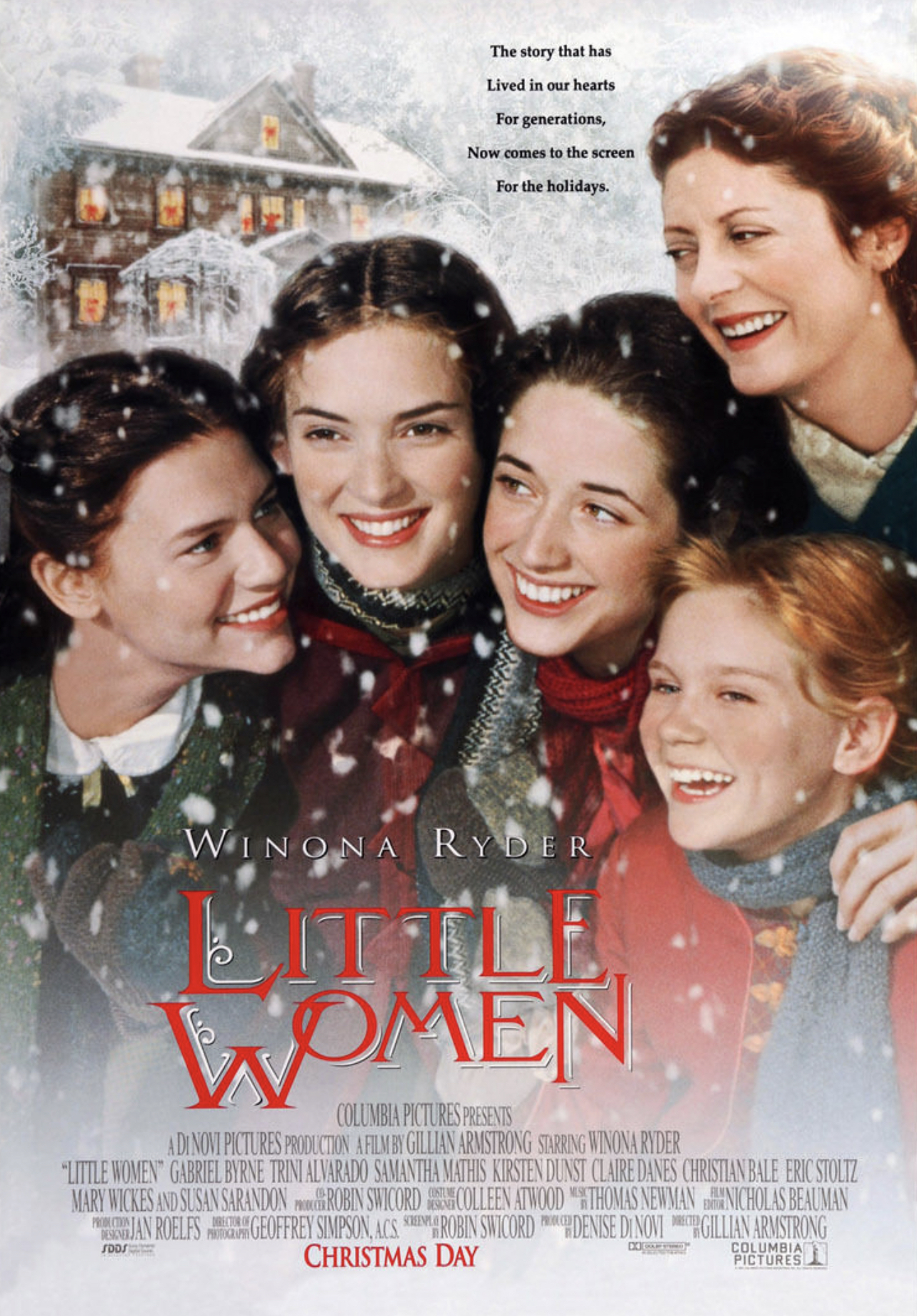
1994 MOVIE
I am not the biggest fan of the more classic movie. For me, the issues in the book carried right over into the movie, and the end stayed just as unsatisfactory as it always had been, though right after reading it I didn’t feel quite as strongly about Jo and Laurie. Also, I don’t like the way Susan Sarandon played Marmee. On the other hand, if you want a gentle, sweet, and sad movie that is pretty decent, then I won’t tell you that this is a bad movie, because it’s not. And there is something about Winona Ryder as Jo. Endearing.
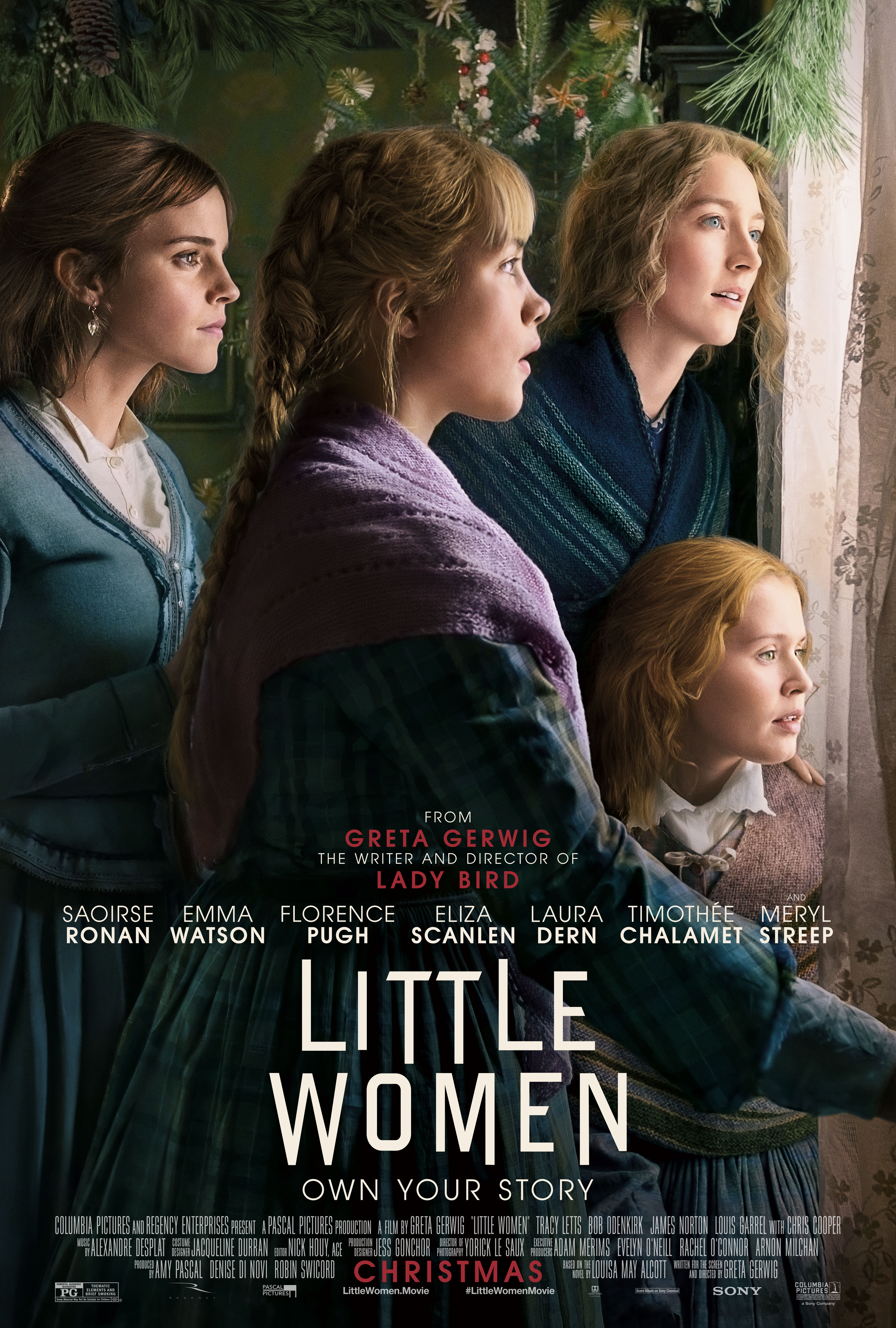
2019 MOVIE
(This is my held review from a year ago.) We had a Starz trial for a week, so I was glad to see I wasn’t going to have to fork over three bucks on a movie rental. I would have, though: I had been wanting to see this movie since it came out. I mean, Hermione. And after I watched, I also realized I have a thing for Greta Gerwig, who directed this version. I thought it was a wonderful version of the story. In fact, I believe that Gerwig fixed the spots in the story that I had found problematic all my life. She stuck so close to the original and then only deviated when it was an improvement, kinda moving things around a little bit, emphasizing this or that, having an actor play a character a certain way (Laurie roguish, Beth painfully shy, Amy practical)… Highlighting these characteristics actually enhanced the story. The costumes were better than they had a right to be. The cinematography was clean. The story was better chopped up and also with the added moments of audience-awareness. The actors were all great, I was just distracted by how young Laurie looked, especially as time wore on. He couldn’t help it, I suppose, but it was awkward, and—despite many others’ opinions to the contrary—I didn’t find him magnetic enough to play the role. So, if you’re going to read this book and then want a movie to watch, watch this one. In fact, you don’t even have to read the book to enjoy this, especially if you like period dramas and/or romance.


 the starving artist