
A Good Girl’s Guide to Murder by Holly Jackson is a fun, fresh read for someone of any age (above 13) who enjoys crime, murder mystery or thrillers, even if they don’t read them regularly. It is YA, and the MC (main character) is having a coming-of-age moment as she does her amateur sleuthing, but the story itself and the way it is presented is pleasantly solid as well as entertaining and modern. Like a combo of traditional and contemporary. And there aren’t too many reviewers who don’t appreciate Pip and her romantic interest (which is really in the background for this book, at least). It’s more about the disillusionment of the privileged when they encounter people’s real, messy lives and the lengths to which people will go for happiness and peace. It’s quite ugly. But that probably gives you the wrong impression. It’s fun to read.
Good-girl, high school senior Pip is applying to top-tier colleges and hanging out with her close friends and lovely family when she decides that her senior project will be an investigation into the five-year-old murder of the town sweetheart, Andie, by her boyfriend, Sal, who then killed himself. Something about the whole thing didn’t seem right to Pip, and certainly the racism that it engendered about Sal and his still-present family wasn’t right. But as Pip digs deeper and deeper, ignoring the warnings of her teacher and the concerns of her friends and family, Pip discovers that the town secrets merely begin with the murder-suicide. And when things become increasingly personal for Pip, someone clearly wants her to cease the investigation at once, or else…
I already blogged about this elsewhere, but the short of it is that I was in a small town in Tennessee (well, actually, outside of it in the middle of nowhere) and I could not find a bookstore within an hour’s radius to save my life. I ended up at a Walmart. It turns out that Walmart’s small book section specializes in popular YA, which is one of the genres I am busy reading right now because I like it and also because I am writing two YA books/series at once. This book was on my YA TBR and so I snagged it. Read it before bed in a trailer by myself in the middle of BFE, in the middle of the night. This was not a great idea.
However, clearly, I enjoyed it. In fact, what I wrote in my notes afterward was, “Loved it. For what it is, perfect.”
This story is told from the perspective of Pip, but uses her project notes for, I dunno’, a good half of the book’s content. Interviews. Actual notes. Articles. That sort of thing. (Less as we near the end, where research winds down and the story itself ramps up.) So that makes it epistolary, at least in part. I am getting tired of eating these same words over and over, but I don’t really like epistolary novels and yet it worked this time. (It also worked for The Guernsey Literary and Potato Peel Pie Society, The Loneliest Girl in the Universe, The Perks of Being a Wallflower, and The Screwtape Letters, and those are just some of the epistolary novels I have read this year and liked. Has this become more popular? I think it’s always been a more popular story-telling device than I realized, but perhaps new writers are using innovation to make it feel better? While it’s a harder sell for me in the old style?) Pip’s case notes are central to the story, both as a prop and as a plot point, so this works here and gives voice to the many people who she talks to or investigates, while keeping many things just opaque enough to have us wondering and theorizing, little sleuths ourselves (which is an important quality of a mystery).
An important quality of a thriller is keeping one at the edge of their seat. I devoured this book because I wanted to know, and I thought the tension was admirably deft. I suppose it was pretty normal in this way, but I was kept guessing. In the end, I was right about most of it, but not all of it, and that is a book-win for someone like me who intuits plot often a little too easily. I question the tension that Jackson built around one character, partly because I’m not sure she did it on purpose or was aware of it, and she doesn’t resolve it in the end, but I talked to another reader and we had had the same experience, on the edge of our seat wondering if it was a red herring. Whatever.
There are a couple points where things suddenly felt unbelievable. Like when some stuff was lost from a computer. Well, I’ve had a laptop break on me in the past several years and (thankfully) it is really not that easy to “lose” things on a computer with all the cloud backup that happens these days, not to mention that teens most often work in online apps as opposed to on-computer software. So, while this was kinda dealt with, there was a character that bet everything on this loss of a computer meaning a loss of everything, and that’s just not the way things work these days, especially for young people. Even I know that and I’m old (not really quite yet). And there also came a time when it was obvious that Pip would have finally gone to her parents about things, and she totally didn’t. I mean, the whole book established the great relationships she had with her family members (something I love when books do, because it is so rare) and there were reasons that she wasn’t sharing (if a bit annoying). But then the reasons are removed and… nothing. Not to mention the few times Pip pulled one of those super-obvious-not-to-do-while-investigating-a-murder things. And she was such a smart girl. You know, like when the kids run into the barn full of sharp items and hide there. Like that. Those I kinda get, for the genre (like I can suspend my belief for the thrills), but the other two I think were just not dealt with quite right.
But I’m not complaining. It’s maybe not a perfect book, but it’s pretty darn close for what it is.
There are two more books to make this one a trilogy. I am unclear how many people go on and read it this way, but it is not necessary. There are some smaller questions left hanging at the end of this book, but pretty much all mysteries leave some of the peripheral stories open. The main things are all tied up. Or so we think. Book two deals with some of these other, mysterious plots that popped up in book one and Pip’s continued growing up and relationships. Book three takes a real turn, so I’ve heard, into the dark side, which if you think about it, is inevitable for this beginning, but does seem to shock and disappoint people who love Pip as a good girl. Apparently, it’s a real roller coaster ride of a series and it has its ragingly devoted followers. I am curious to continue the series, but that’s not going to happen now. I am syked to go down the rabbit hole with Jackson (who claims that is always where this story was going), but I also want to hang on to the sweet Pip. So we’ll see. The series is:
- A Good Girl’s Guide to Murder
- Good Girl, Bad Blood
- As Good as Dead
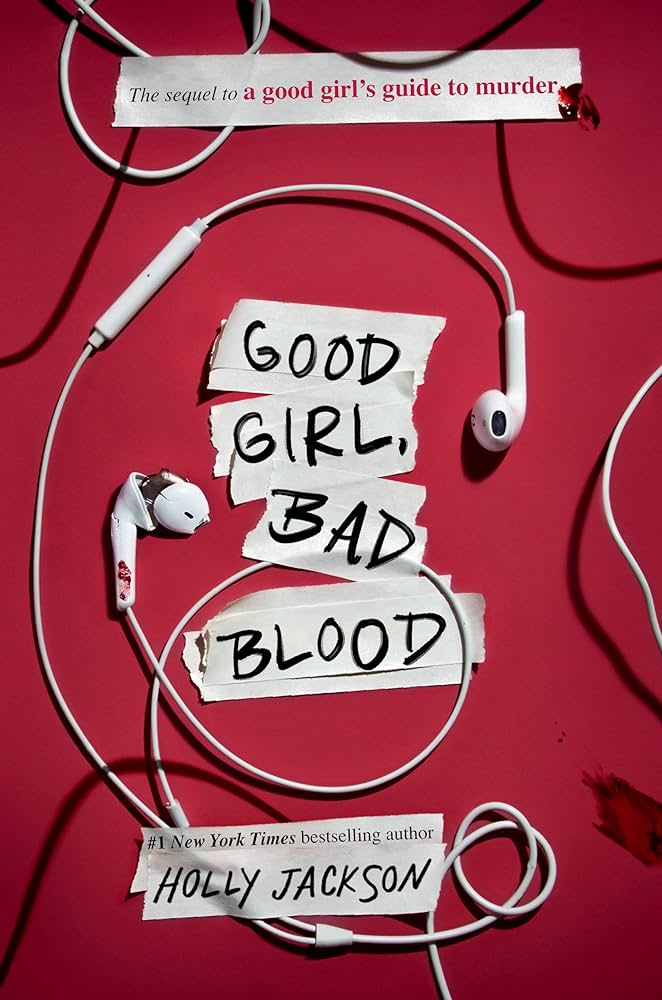
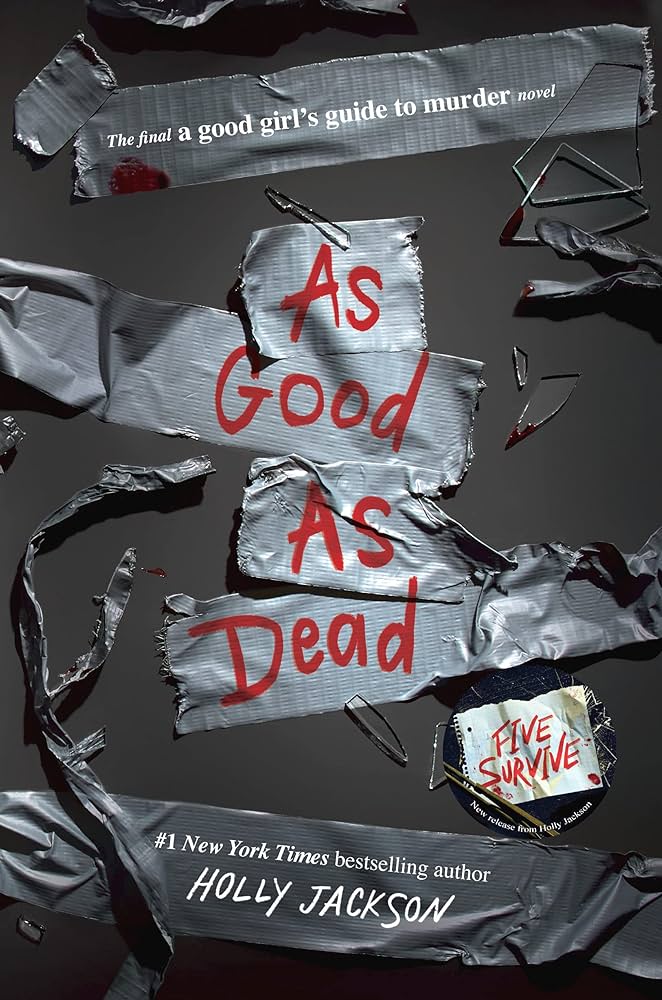
You like mysteries? Thrillers? What about YA? The mash-up of those genres is real big stuff, right now, and I think this book (and the trilogy) will stay floating at the top of the best of these, maybe forever. At least for a good long while. The innocence. The underground of what looks like respectable society. The jump scares. The knuckle-whitening moments. The pages turning well after bedtime. It was that sort of read for me and for many others. It would make a great vacation read, but maybe not when you’re alone in a trailer in the middle of nowhere in the complete dark and you’ve been uncovering someone’s secrets.

Holly Jackson writes YA. A Good Girl’s Guide to Murder was her first and was hailed as a triumph right away. She is very prolific, finishing the series and a prequel (Kill Joy) in just a few years, as well as a stand-alone book, Five Survive. She has another book coming out in 2024, supposedly, The Reappearance of Rachel Price. I, as well as many others, I’m sure, am curious to see if she is the kind of author who can keep coming back and writing really great stuff. She’s a young, British lady and I don’t see that much about her on the internet, though you can follow her on Insta or Twitter (HoJay92). Penguin Random House says she likes playing video games and watching true-crime documentaries. She has always written, and studied English at uni.
NOTE: I was surprised that she wrote her first book about a town in the US, until I learned that she didn’t. This book’s setting was Little Kilton, Buckinghamshire until the publisher (with her) changed it for the US to Fairview, Connecticut. Um. I suppose this is why the town’s set up and relationship to the surrounding area seemed off to me. (Whoops. Forgot to mention that in the review.) I really wish they wouldn’t have done that. But they must have thought marketing this type of book to American, YA readers meant it fit better as an East Coast story. I can see that, but it does leave a low, sour note sounding in the background for much of the book. Like, is it a small town? Near a big city? So, a suburb? How does it feel so isolated? They must have also “translated” the book in other ways.
QUOTES
It’s not really a quote kind of book, especially as you are flying through it just waiting for the next plot point to hit.
“If a villain can be made, then he can be unmade” (p259).

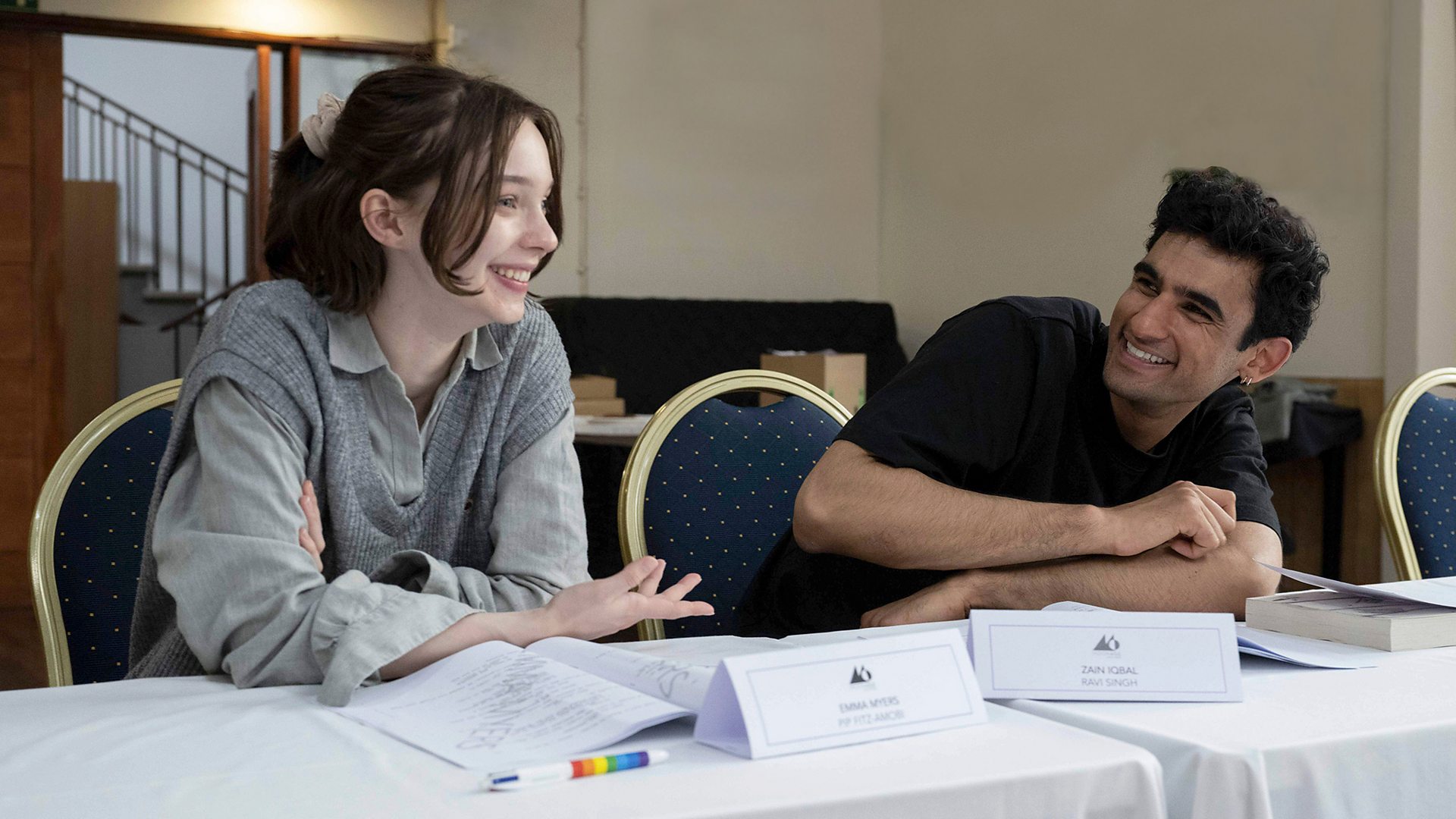
Despite it being pretty new, the enthusiasm for this book (2019) and series (-2021) has put it on the fast track. It starts production right about now and has a cast and all the other stuff lined up. The idea is to do three seasons for the three books and we already know the first season will be the first book and will wrap up like the first book, so not on a cliffhanger. It will take place in England, which I am curious about, as the many, many fans in the US are sure to watch the first episode and go, “What?! Why did they change it?” But the change had come back when Jackson re-wrote the books for an American audience. The actors set to play Pip and Ravi are going to gain big points for the franchise, however, and I am excited to see the show’s first season in, what?, the next year or two?
UPDATE: As excited as I was about this series, I was not so excited once I started watching it. The tone wasn’t quite right. And the setting (change) was straight-up bizarre. Ya’ll, an underground cave system full of ragers does not exist because caves don’t look like that. It wasn’t in the book. I don’t know why we made this up. Overall, I would say the series was somehow lackluster, enough that my daughter and I kept forgetting to return to it. But in the end, we did, and there were things I did like about it. Like her fits. And Ravi. I think part of it was how much they simplified the story and mystery for the screen. Also, I had a much harder time dealing with dog violence in TV form than in the book.


Brilliant!
great book overall i would give it 5 out of 5 it is my favourite book and lets just say i am not a big time reader so if i read all three books without losing intrest i love the book
“There are a couple points where things suddenly felt unbelievable. Like when some stuff was lost from a computer. Well, I’ve had a laptop break on me in the past several years and (thankfully) it is really not that easy to “lose” things on a computer with all the cloud backup that happens these days, not to mention that teens most often work in online apps as opposed to on-computer software.”
Just wanted to mention that Pip did that on purpose, and she actually destroyed the evidence, but kept some pieces of physical evidence. Also, Holly Jackson wrote the book in 2019. Maybe there weren’t many cloud saving software back then.
Thanks for visiting and sharing your opinion!
I will stand behind my take, however. The dates are right for this tech–the issue is that modern tech is a big hurdle for authors and I think it was standing in the way of a good story here, just like it often does.