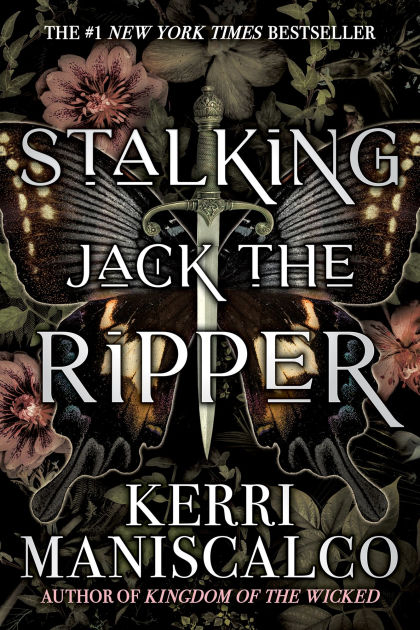
Oh, I have some things to say about Kerri Maniscalco’s Stalking Jack the Ripper.
The first thing is that I did not actually finish this book. I’m being honest. But I read more than half and attended a book club, listening to lots of other opinions (plus reading reviews online). (I also skipped ahead and read the end.) I can safely say that I have read enough to review this one.
Blurb: Audrey Rose is a young lady in Victorian London, where a string of gruesome murders has begun to haunt the streets. But Audrey Rose doesn’t want to be a proper lady if being proper means not studying forensic medicine and assisting with her uncle’s basement autopsies. And when the bodies of the serial killer’s victims arrive on their operating table, she wouldn’t sit home and watch things unfold for the world. Even if it means putting herself in danger. Even if it means the investigation gets a little close to home.
Of course, I give you that blurb because that is technically what the book is about, but it’s not really what was executed on the page. It’s really more of a series of anachronism-riddled vignettes involving a conflicted, anti-feminist teenager (who thinks she’s very feminist and way smarter than she is) who falls head-over-heels for some kinda-sexy, kinda-mean (but smart!) guy and bumbles around a deadly city kinda-sorta toward a killer. I realize that plenty of readers (especially YA ones) are able to read this book like it’s the one they expected, just filling in the holes with their desires and imagination, (it’s popular and rated mid) but yikes. This should have been a book I really enjoyed. It was clearly not.
Let’s just take you on my journey and let that be that.
I started the book ready for a great read (and a few more in the Stalking Jack the Ripper series afterward). I’m a Sherlock Holmes fan. I read (and write) YA. Jack the Ripper might be a bit much for me, but I was willing to try because I often like darker books than I think I will. I love steam punk (which this is trying to be but not quite succeeding). I’m cool with classic monsters and even moreso with classic stories.
By the time I made a notation at page 35, I knew this book was not my thing. As with many poorly-written books, the first chapter is by far the best, leading the reader to believe things about the later writing that aren’t delivered. Even so, the intriguing autopsy scene is not great, sometimes confusing (spatially), characters surfacy and big questions almost nonexistent. My comment on page 35 was in response to the line, “Science never abandoned me the way religion had that night.” Thumbs down. We’re already leaning so hard on telling (including her first person POV stuff) instead of showing, and this is only one of many, many, too-easy, immature thoughts.
On page 39, I asked “What?” to this beauty: “Without waiting for the drunken couple to pass, I willed myself to take on the stealth of an apparition, floating soundlessly down the alley and across the road.” I see how a reader could just be like, “Cool. I understand that she’s sneaking down the alley and across the road.” But a careful reader would be like, “What fresh nonsense is this sentence?” So she walked out with the drunk couple? She willed herself to be soundless? Is that a thing? Then she floated? Not to mention: too many words. (This is a complaint I had about most sentences in this book, actually.)
After a couple little notes about wrong word usage that I just couldn’t pass by and a couple random “real” photos that added zero to the book, I came to this one on page 111: “…a grinning white skull on a black flag…” Oh boy. Yes, it is true that this book is brimming with cliches. It is also true that a skull cannot grin. And that the word white is unnecessary unless changed to a more interesting adjective. Again, you could just get the point and move on. I was having a harder and harder time doing that.
Or this nonsense on page 115: “It was impossible, but I swear I could’ve almost heard the last few strained beats of the man’s heart as he bled out in front of me.”
On page 133, I marked two instances of telling, not showing: “Thomas Cresswell was not charming to anyone other than me occasionally, nor was he polite on a good day.” And “He paused and looked around before leaning close, an almost familiar scent lingering on his skin.” To which I responded, “First, tell us the scent. And second, let us make connections!”
Chapters thirteen through fifteen were the dying breaths of my patience. They included these desperate moments:
- “Walking into Uncle’s basement laboratory with uninvited guests rummaging about like scavengers was its own nightmare, plucking at the ligaments of my bones” (p135).
- “…I slowly turned in place, my eyes two unbelieving orbs in my head” (p135 and ha! Ha! Ha! Make it stop!)
- “Thank heavens Uncle wasn’t here; his heart would be sheared in half” (p136). Keep in mind that she’s comparing him watching his lab be ransacked, versus his being imprisoned in a Victorian insane asylum and suspected of murder. Thank heavens he wasn’t free and at home!
- “Father, though he had the right connections, would rather see his brother hang than assist him in any way” (p136). Yes, more telling, but also what? Really? There’s another incident two paragraphs later when another so-far benign character is accused of saying she’d be front and center, cheering and handing out Indian treats (that’s a whole other issue) at the hanging of one of her relatives.
- “It seemed it’d take a little more time for some girls to free themselves from chains society places upon them” (p149). A moment to stop (untangling your brain’s tongue) and think about how weirdly anti-feminist this book and the MC are. Audrey Rose really thinks she’s got it all figured out (but comes across more as a gen Z girl who’s been dropped into the time period), but she hates and judges unfairly every other female character in the book (who are barely there, to begin with). Also, yes, the book is crammed full of platitudes and cliches.
- “The show was everything it promised to be and then some (p159). Cliches.
- “There were aquatic acts, more horse acts, and acts taking place high in the sky.” Vagueness.
- “Hatred was drenching my entire being with its oily residue.” Ha! Ha!
At page 158, I let myself edit a couple pages, just for funsies. I corrected an insane number of paragraph breaks, a number of passive sentences, self-aware horses, three paragraphs with more than twice as many words as they should have had, a couple modern slang instances… and gave up at this: “Traditional mendhi paint swirled and wrapped around her palms, wrists, and feet. We’d passed a booth where women were being painted with enchanting designs.” I can’t fix that.
At page 170, I cut the cord. Before book club, I skipped to the end and read enough to find out what happened. Then I read some spoilers. Now I am going to give the book away.
Because, as someone shared at club after I read the “two unbelieving orbs” section aloud, “I see it now [meaning the poor writing, etc.], but it doesn’t matter. I enjoyed this book and I’m going to keep reading the series.” Also, several people who did read the whole series (many? all? in their teens at the time) said the series gets better. (Not better so much in the ways that I need it to. So, no thanks for me.) Which means that you might enjoy this darned book. And you would be allowed to. But if you read like me, don’t even attempt it. It’s impossible to ignore the many, many issues (several of which I didn’t even bring up here including my main beef, which is that I find almost nothing about the book (characters, plot, setting) to be convincing. See other scathing reviews).


 the starving artist