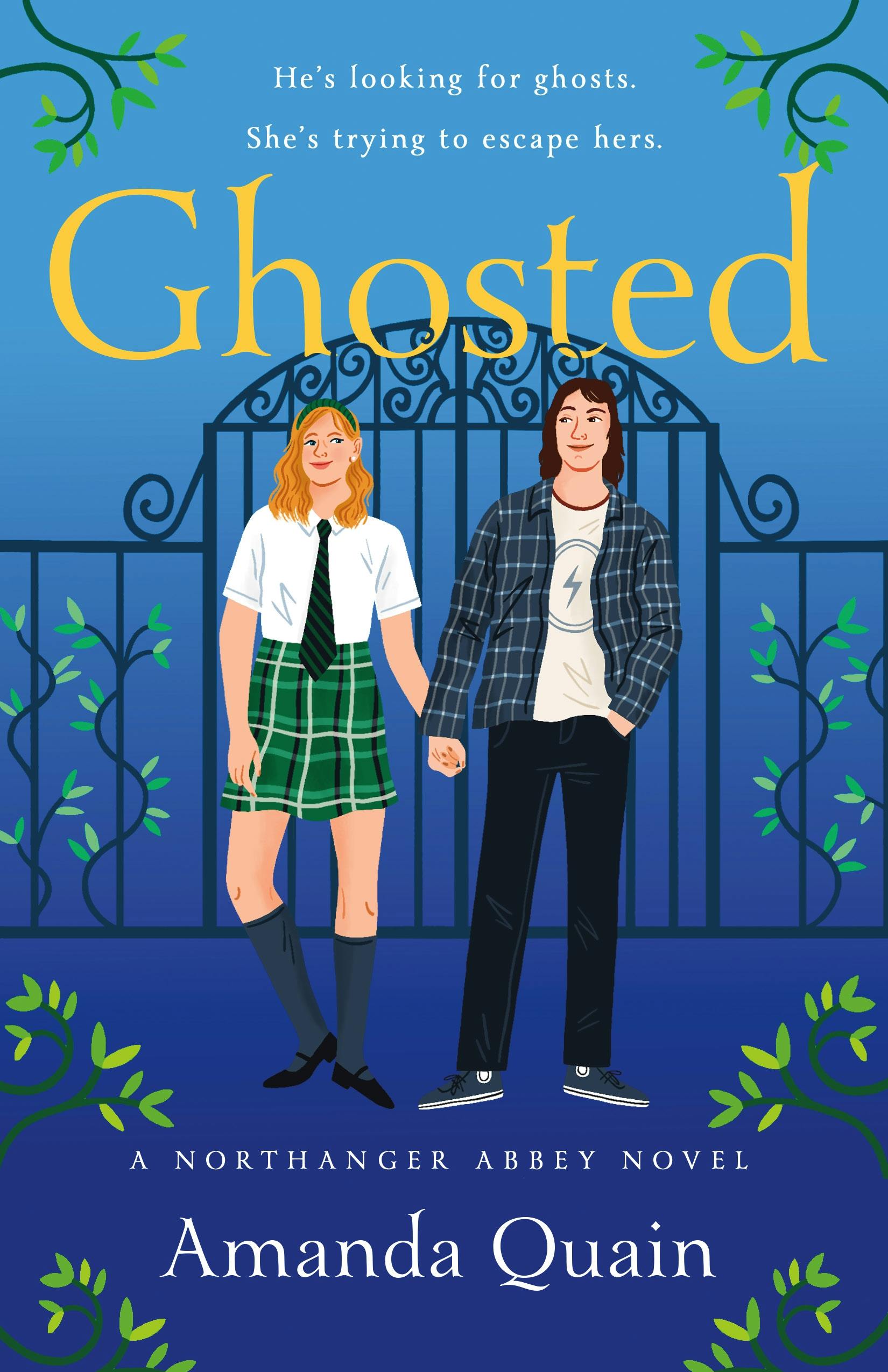
Ghosted by Amanda Quain is one of those YA books that is mostly meant for teen readers. I would say more than half of the YA books I read are more universal, but there you have it. That’s obviously more than okay. I enjoyed the read, to an extent, just maybe not as much as I wanted to. The academic world and the origin of the story were right up my alley, and I appreciated some of what it had to say (in a light-read big on coming-of-age themes), but it was also predictable and not especially deep or perfect. It’s fine. Kinda cute. And the romance basically worked. The motivations also basically worked, but there was far too much telling and directness (like the inner dialogue was full of statements about Hattie’s feelings).
On Goodreads, Ghosted is listed as “Northanger Abbey #1” but this is just not a thing. The book is, however, a modern YA adaptation of Northanger Abbey. Loosely. With references to other classics. It’s also “gender-bent,” but that’s a bit of a misnomer. Some of the characters are gender-bent and the main character and love interest are blended (with characteristics and situation) between the main character and love interest in the original, which if you haven’t figured out by now is Northanger Abbey by Jane Austen.
Synopsis: Hattie goes to the most haunted boarding school in the US (Northanger Abbey) because a) her mom is the hard-ass principal and b) she used to want to go there, really bad. But after her dad died, she had no more reason to keep ghost-hunting. Maybe she even had reasons to avoid it. If she just keeps her head down and gets all As, she can move on from this stupid place and please her mom/principal at the same time she avoids her older sister and takes care of her younger brother. But when her mother makes her a mentor to the new kid—the one who’s there on a ghost-hunting scholarship—and she ends up having to do a journalism project with him as well, things are not going to go according to her carefully laid plans.
I would give this 3.5 stars. I certainly didn’t hate it. I mostly enjoyed reading it. Was it well-written? Unfortunately not. It definitely could have had a tighter edit and could have been shorter and less over-explained (and less repetitive). Less on-the-nose. Quain should have told us a story instead of being inside the narrator’s head all the time, telling us how she feels. Yes, this is part of what makes it YA. But I really missed a real sense of place and also of naturally-developing plot. And as for all those hip, modern phrases like “a nonzero amount of…” Ehn. I was rolling my eyes, but I am 45. It felt like it couldn’t age well.
Honestly, there were a lot of cool and valuable lessons at the end. But did the text earn them? I don’t think so. Also, I liked the ending. But did the text really lead us there? Also I don’t think so.
I really like Northanger Abbey. It is one of my favorite Jane Austen novels and in case you didn’t know it is a satire of Gothic novels written as a Gothic novel about a girl obsessed with Gothic novels who finds herself inside a real-life Gothic novel. Or so she thinks. It’s further afield from Austen’s other books and is one of her two “place” novels (with Mansfield Hall) though I don’t know if that’s that important. All of her novels have a solid sense of place and also feature a central romance and a female protagonist in a comedy of manners. Northanger Abbey is no exception.
Ghosted, on the other hand, is a YA cozy romance (with the romance sidelined to teen trauma/grief and realistic faults and growth), pretty slow and very internal, not very Austenesque. (I mean, most of the main things that work for Austen’s novels just don’t translate to today. Seriously.) But the setting of a haunted boarding school was great. And I loved Kit, the Timothee Chalamet of the ghost-hunting world. I was happy to see kids make mistakes and have to deal with them and with adults getting a break. The villain(s) aren’t necessarily who you think they are. And friendships matter just like relationships and family matters. But if you’re waiting for an actual ghost to show up and make this an actual ghost story… you’re going to be waiting an awfully long time. I read it a couple weeks before the book club met and I already couldn’t remember it super well, which I think means something.
One book club member put it this way: “I enjoyed it how I would enjoy a Hallmark movie.” Nailed it. But many of us reported getting teary-eyed or actually crying while reading. And the message that ghost stories are just another way to talk about history is a really cool one. I probably would have loved this as a teen, especially if I had already read some Jane Austen, but even if I hadn’t.
“An early journalistic lesson for us all—don’t sit on your surprises when there’s a chance there could be a leak. And, trust me, there is always a leak” (p43).
“We’re a speck in the infinity of existence, and to assume we know anything about anything is profoundly arrogant” (p98).
“If you’re believing in something, it’s because there’s a chance that you’re wrong. But you hopw heyond all hope that you’re not. And that hope is what keeps you moving forward. It keeps you pushing, looking for answers” (p306).
“The idea that I’m a hundred percent right or you’re a hundred percent wrong isn’t…it’s not just that it’s not correct. It’s not interesting. Belief leaves room for nuance. It has to, if you’re going to live you’re life by it” (p306).
“But she can still be wrong and still not be the huge villain you’re suddenly determined to make her” (p331).
“You don’t magically get a road map for being a perfect person once you grow up” (p333).
“You’re getting better confused with easier” (p333).
“…I was starting to suspect that getting older, growing up, was about more than just graduating with good grades and going to college or whatever. It was about knowing how to have the conversations that sucked” (p349).
“We didn’t need to have some Hallmark movie version of a mother-daughter relationship for oue relationship to have value. As long as we loved and respected each other, that was enough” (p350).
…it seemed important to remember, this might go terribly—just the going after something I wanted was the important part. If I managed to grab hold of it…great. If not, then just the trying was still good. Still worthwhile” (p362).
“And I’m not here because I think you’ll fix me. I’m here because I’m read to try and fix myself, and I want you with me for the journey” (p365).


 the starving artist