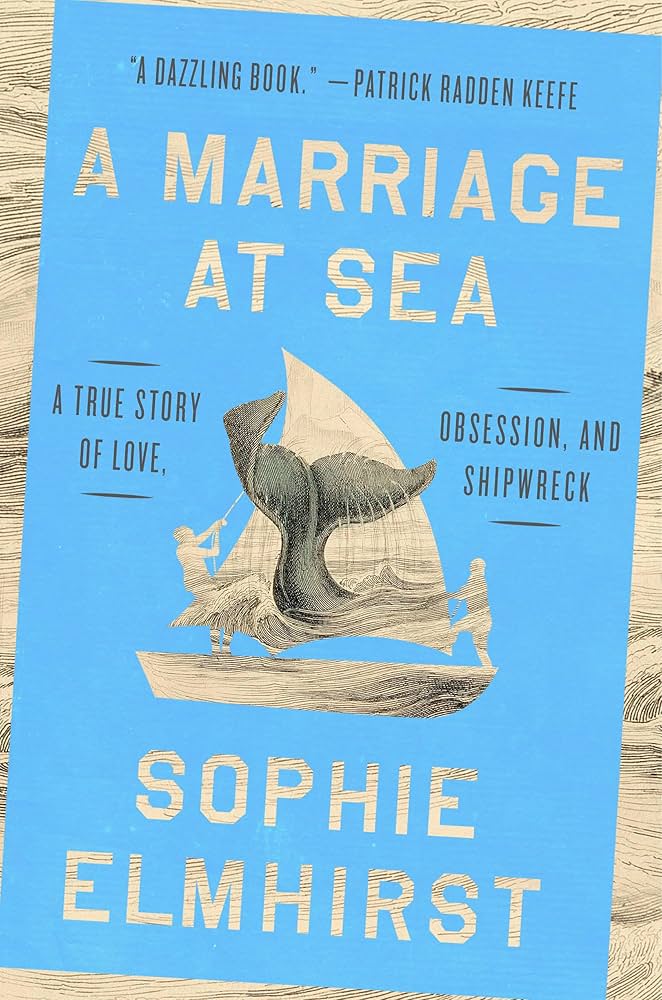

I’ve heard a lot of good things about the nonfiction book (“that reads like fiction”), A Marriage at Sea by Sophie Elmhirst. It’s a Ten Best Books of 2025 with The New York Times Book Review and a best book according to NPR, Time, The Guardian, The New Yorker, Fresh Air, USA Today, and more. It currently has a 3.79 on Goodreads with 75,000 reviews, which should be considered because of its relative popularity (for nonfiction) and disregarded because Goodreads tends low on nonfiction (and also literary, and high on sequels). I heard about the book on a few podcasts (back when I could listen to them because I didn’t have multiple audiobooks to listen to because I’ve over-committed myself as a reader). Out of curiosity and some amount of confidence, I added it to the bookshop’s book club reading list for September, 2026, because it would be in paperback by then, but still “new,” however, it would be our first foray into nonfiction.
Blurb: It’s the 60s and Maurice is just some dude in England, hair already thinning and a bit of a loner. He doesn’t think he’ll ever have something in his life like the boisterous Maralyn, but he asks her out, anyway. They dive headlong into life together and both get really into boating, start planning their escape from their dead-end life on land. But there are some lessons they perhaps should have learned before jetting off around the entire world, though a whale emerging under your boat in open sea is just plain bad luck, statistically-speaking.
After next month’s nonfiction (memoir, Raising Hare), I may want to revisit the decision to include nonfiction at all.
Because I am no longer confident. Marriage at Sea is not quite the book I expected it to be, mostly in presentation, style, and tone. I would not say it reads like a novel. I would say that these two characters are kinda boring and not particularly likeable (I’m being kind, and which has its own interest, but only so much). I would say I’ve read this before: survival at sea, starvation, relentless sun, eating raw fish… What saved it for me was actually the third part (of four), in which the couple navigate an after-life that they had never expected and were ill-prepared for. This was something I hadn’t read at least a few times before. This was interesting to me. (And the fourth section, it did make sense of the book, so I can allow that, as well, I guess, but it was rather depressing.)
The “adrenaline-fueled high seas adventure” and “gutting love story” be damned; this is a much more quiet and methodical book than what I was set up for. 300 percent less romantic than A Severe Mercy by Sheldon Van Auken (another nonfiction married couple lost at sea—though one could argue that was too romantic). In fact, this book makes me want to go back and re-read the other one. Caveat: if you are not a Christian, the religious bits in Severe Mercy are likely to be too much for you.
I did listen to the audio, simply because I needed to begin while I was still finishing The Loneliness of Sonia and Sunny. And I accept that given the reader I am, I would probably have liked it better with my eyes on the page. It’s not a long book at 240 pages, but listening to it made it feel longer for me. The audiobook talent was more than adequate; however. I sorta wished they didn’t have a British accent because I have trouble understanding accents, but obviously I understand the choice. It wasn’t as difficult to understand them as I had feared when I began.
Look, I thought this book was okay. I think I came to it with too much of a build-up and should have read it with my eyes. But it wasn’t really what it was promised to be, so part of the fault here lies with the marketing, the packaging. It is a pretty chill book about painfully ordinary people and their painfully ordinary marriage—basically from their childhoods through their whole lives, focusing on the shipwreck and its aftermath. If you’ve never read about being stranded at sea, I’m sure many things about that part will surprise you. If you have, then perhaps the holistic approach to how the shipwreck affects their lives (and how their lives affect the shipwreck) will be what draws you in. It’s an interesting nonfiction read. It goes down pretty easy.
I will say a little more once I hear what the other book club members have to say about it.
As for club tonight, I will be making a Victoria Sponge (the quintessential British cake of the twentieth century, and one Maralyn likely dreamed about while trying to mentally survive at sea) with coffee and tea. The icebreaker question will be: Would you sail around the world? Under what circumstances?
Update: I was perhaps a little surprised that almost every single person at book club “liked” but “didn’t love” this book, and at least one other cited how hyped up it was as part of the disappointment. It just can’t live up to Obama’s favorite book, so we decided. We did discuss a few things I forgot to mention in the review, however, which is Maurice as a neurodivergent person (autistic) and, I think, probably depressive. He was called a “tricky” character, largely static, and in fact, he seemed to get meaner and more controlling as he got older, a disappointing arc that one member chalked up to grief. Both of the MCs, really, were “strange birds” and we wondered about the accuracy of a journalist getting it right when there was plenty of access to their journals and such, but they seemed to share (especially him) details (so many!) more than emotions. At least one person stood up for their marriage as “beautiful and intimately connected” while another defended that their lack of insight and transformation is more real than the opposite. Most people commented on it being disjointed and choppy, though it is a journalistic piece, so you work with what you have. Also, the vast majority of us were engaged only during the adventure part of the book (part two of four) while I (as mentioned above) was most into part three, the return to society.
Looking forward to the next book, which is nonfiction again, but a memoir.


