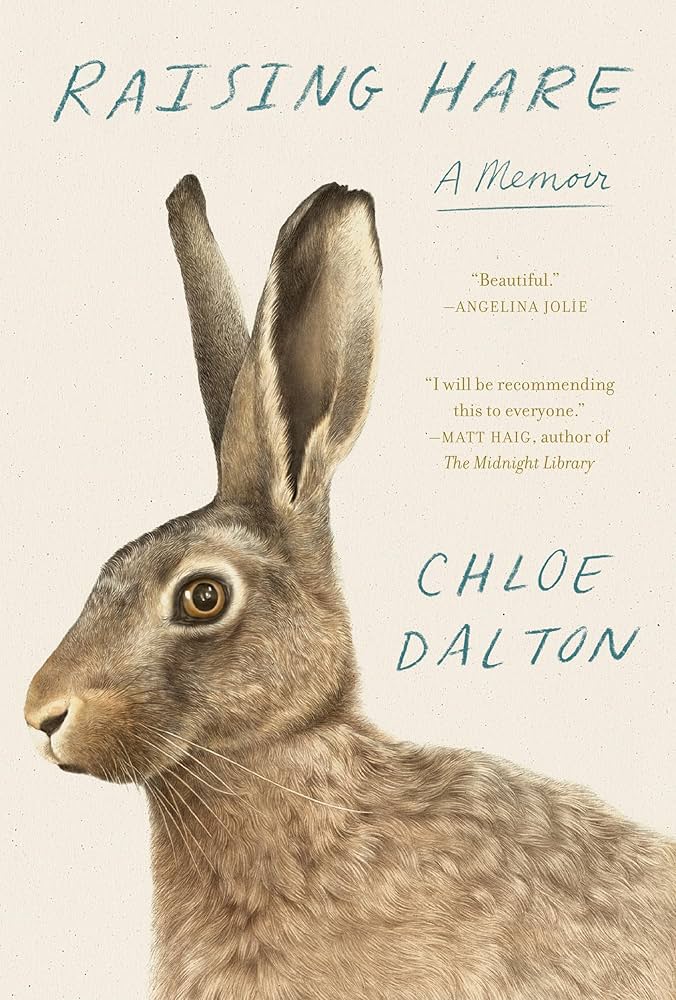

I have been hearing good things about the memoir Raising Hare by Chloe Dalton (not the Australian soccer player) since it was published in spring of 2025. I read nonfiction, but not nearly as much as fiction, and I’m harder to please with nonfiction. I put Raising Hare on the list for the book club I lead and waited for the paperback and then the months to pass. I accidentally ended up with two nonfiction reads in a row, and I had also heard great things about A Marriage at Sea by Sophie Elmhirst but was not its biggest fan. Which means I started Raising Hare expecting very little.
Raising Hare is shooting straight to the top of my favorite nonfiction books.
Blurb: During the Pandemic, Chloe Dalton is cut off from her usual life of politics, world travel, and an absorbing career. She flees London for a barn she’s renovating in the countryside when she stumbles upon a baby hare (a leveret) in distress and faces the first of many choices of how to help a creature without infringing on its wildness.
Yes, Raising Hare is a Pandemic book. It is necessary for the set-up, but it is not heavy-handed. I am not one of those people who want to avoid the Pandemic, anyway. I think it’s good to talk about it, drag that whole thing out into the light. This is Dalton’s Pandemic story, and it’s a wild (pun intended) one, full of twists and turns.
In an interview at the end of the audiobook, the book is called a memoir mixed with natural history and a manifesto. This is accurate, though the manifesto is mostly felt until the last few chapters (at which point there is one chapter that almost lost me for the first time in the whole book. But momentarily.) The thing is, I was totally absorbed in this book. And this is going to sound weird, but the hare in this story is one of the most endearing and interesting characters I have ever read. I think this is largely because of the way Dalton writes—florid, thoughtful, calm, and respectful—about everything, but especially about the hare. She is invested and curious, and now I’m invested and curious. I’m normally curious, and I also really enjoyed the inserting of factoids about the British countryside, plants, animals, and (mainly) hares.
I read this pretty short book (285 pages) in no time at all. It went down real smooth and fast. The writing is wonderful, actually, and I was surprised by Dalton’s transition from foreign policy specialist to best-selling author. Most people want to write a book, try to write a book, and mostly suck at it. Dalton had something in her all along that I doubt she knew was there. Marry that with the passion she has about the world around her, ushered there by her connection to the hare. There is so much careful observation and consideration. She changes. She changes her mind. And I’m happy to be there for the process and all the tangents.
I hate to be too positive in any review because I fear I set people up for disappointment. But this is a five-star book for me, and there are many people I would recommend it to. It’s immersive and considered, engaging and also really decent writing. Who knows if she could even create this magic again (or if she’s even trying (she is. It’s called Pet and it’s due out next year)). The experience she had is unique, singluar, special, and Raising Hare is a great book that deserves to stick around.
Note: The audiobook is good, too. It’s easy to understand and straightforward.


