
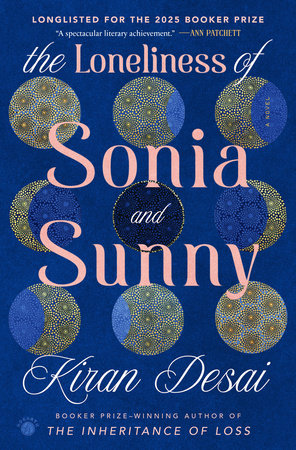
I am going to make comparisons of The Loneliness of Sonia and Sunny by Kiran Desai to two other books. The first is Midnight’s Children by Salman Rushdie. Sure, it also takes place (partly) in India and is long and literary, but it’s more than that: it’s an epic, unfolds over time, and is beautifully written. The second book I’m comparing it to is The Goldfinch. Now, hopefully you have forgotten, but I really did not like The Goldfinch though I appreciated certain things about it. Sonia and Sunny does what Goldfinch does right (mostly the writing style and sense of epic-ness) but betters the pacing and keeps me interested through all the movements. (I just realized Desai went to Bennington, and I am somewhat annoyed.) I loved Sonia and Sunny.
Blurb: Sonia is an Indian student at a school in Vermont in the 1990s. News has reached her family on the other side of the world: she is lonely. With only a few people left on campus during winter break, she has very few options for how to deal with her isolation, and an older artist is poised to take advantage of it. Sunny is in New York training to be a journalist and living with his Midwestern girlfriend when he gets an offer from his parents to marry Sonia. He dismisses it (just as Sonia would if she knew it existed), but the offer will haunt them both around the world and through the years, echoing into a future where they meet and weave into each other’s lives.
So good, ya’ll.
I am aware that the rating on Goodreads is only a 3.69. This happens sometimes to a literary book that gets hyped and ends up in the hands of too many people who read popular fiction and don’t have the taste or patience for a literary read. At least I’m pretty sure that’s what’s happened here. Go look up other award-winning literary books, and you’ll see what I mean. They can never keep up with the ratings of the hottest new romantasy series, but obviously there are reasons that they should be rated much higher. Anyhow.
Kiran Desai is the daughter of author Anita Desai, a name that seems so familiar to me partly because I actually knew a girl named Anita Desai. We digress. She is Indian, was educated in India, England, and the US, and currently lives (I believe) in New York. There is no official word that Sonia and Sunny is autobiographical, but it does “reflect her experiences.”
The book is probably magical realism, though not strongly, and I’m not sure that’s even the right term. I love magical realism, and I would hate for the category to go away, but I understand that it can be problematic for one culture to label something “magical” that another would look at in a different way. As real? Or normal? Or just as is? Are the “magical” things in this book even happening at all? There is so, so much going on in this book and perhaps too many threads, but only if you don’t accept it as a sweeping epic. It is easy to lose track of who’s who and where they went (and it doesn’t wrap everybody up), but I think again of Midnight’s Children or One Hundred Years of Solitude. Those books did not limit themselves to the plot-and-only-the-plot because they were bigger and more complicated by nature. Same here. Don’t expect a regular, ol’ story arc.
In a way, too, the book is a little meta, as in Sonia is a young, female, Indian writer who is told at the beginning of the novel what not to write by an older, white man. Sonia and Sunny is partly a reaction to this scene, which I can’t help but imagine happened in Desai’s life, in some capacity. There’s an exploration of fate versus coincidence. And obviously loneliness in many forms. Being in an abusive relationship and questioning your own perception as a way of being haunted. Etc.
I do not recommend listening to the audiobook unless you have no other way of reading it. I listened to the audio a little, and because there are not a ton of dialogue tags and the writing is florid, it is impossible at times to tell, while listening, who is talking or if what’s being said is aloud or a thought (which there is a lot of. And it matters to the story(s)).
I read this with so much joy. It’s not a joyful book, per se, but it features the type of poetic and exciting writing and lush storytelling that I find enjoyable to read. My breath was occasionally stolen. I wanted to fist-pump in the air or yell, “Stuck the landing!” as I hit narrative highs and certain moments. I can definitely see myself re-reading this, and I would highly recommend it to people who like literary epics like those I have mentioned, or others I haven’t read, like Middlesex or Cloud Atlas or The Nightingale.
I can’t believe this book club is moving from this 600+ page behemoth to East of Eden, but there you have it. Maybe I’ll love that one, too.


