
A Tender Age by Chang-rae Lee is best read with a buddy. Not like while you’re reading it, but it’s the kind of book you want to discuss after (and while) you read. I guess that makes it a good book club read. But since it’s being published today, it might be awhile before it shows up on your book club’s radar. I suppose you could just read bits of it aloud to your husband and make him listen to your thoughts about it, even though he hasn’t read it. Not quite as satisfying. (I should know.)
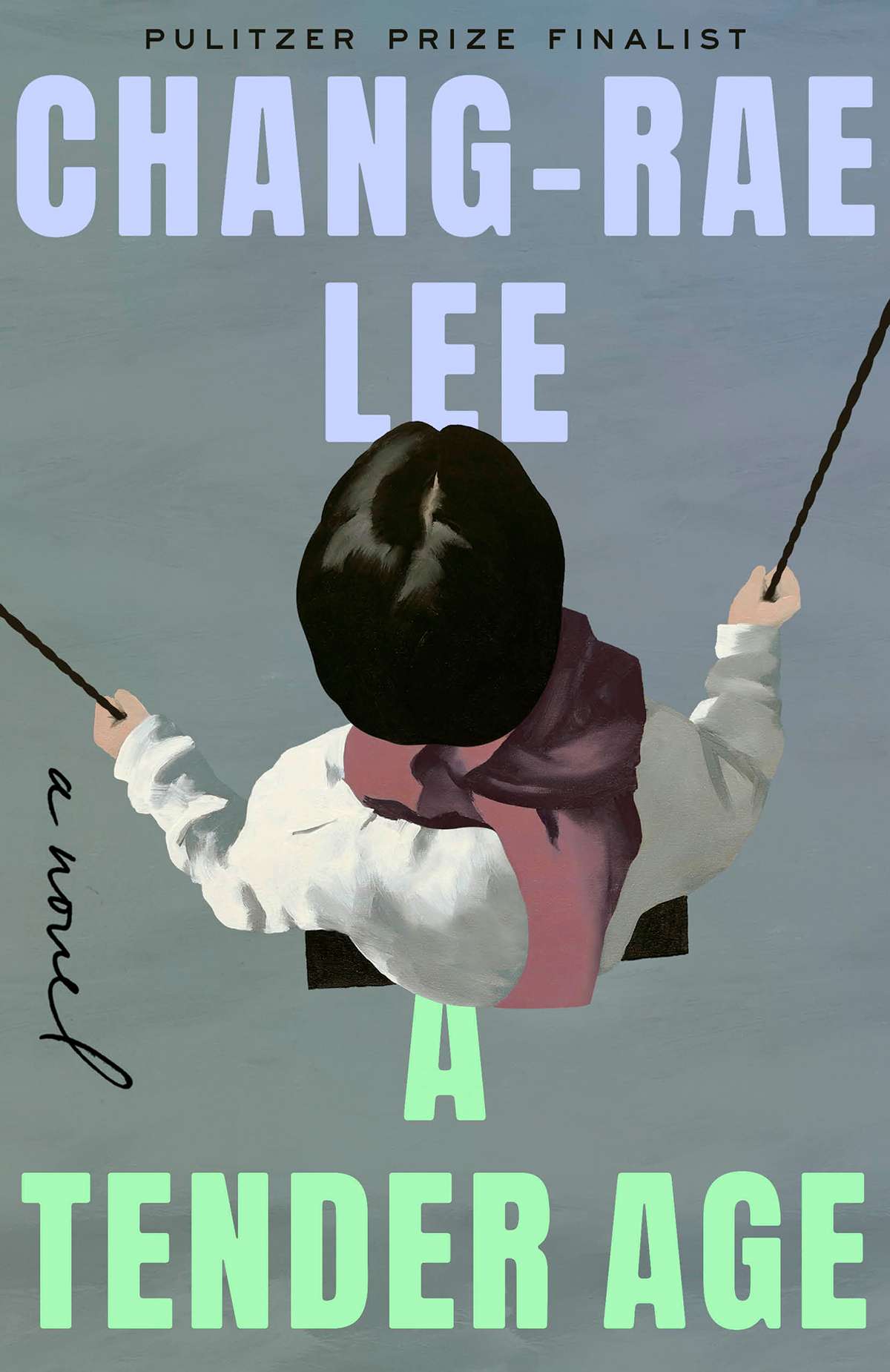
I was holding my opinion close to my chest on this one until I reached the end. Why? Because part of its power is a deftly held tension, so subtle and so visceral, and I wanted to know if Lee would deliver on it. I would say the ending is okay. (It’s a little whiplash-y.) It’s the rest of the book—the meat of it—that is really going to stick with me for a long time.
Blurb: Jeong-Gi (J.-G.) is barreling into prepubescence in the 70s in a mixed-ethnicity apartment complex outside New York City. He is a Korean immigrant, a kid who doesn’t even fit in with a band of misfits. And man does he have some stuff going on in his head, let alone a terrible propensity for bad luck. Plus, these are the tween years, in all their violence and confusion, self-discovery and naivety. And when he makes a hot-headed choice that sends his future down a new and alarming path, the terror only multiplies, and J.-G. has to ask himself, is he a bad person?
This story is told through the voice of J.-G. as a grown man, looking like a pretty usual married dude with kids. (We are given glimpses into the future whenever we might get distracted from the real story by wondering about a particular character who isn’t J.-G.) This is one of two things that didn’t work so well for me. Because of this perspective, it reads like a memoir, but there were so many details that no one would ever be able to recall, that those details pulled me out of the world for a second, broke the fourth wall. And then I would wish that Lee had just told it like “normal,” so I could absorb the omniscient viewpoint and know it as fiction, just very realistic fiction (based on Lee’s life, somewhat, from what I have heard). But then I would wonder what that could look like. Like I said earlier, I think Lee used this narrative choice to keep us focused on the now of the story, the narrow focus of one kid’s tween years, not what’s going to happen in the future. It’s a tough one.
The other thing that didn’t work amazingly for me, and I could see others complaining about: the pacing. Or the story structure. This is literary fiction, and it treads forward relentlessly through the events Rube Goldberg-style that lead to the final pages. These scenes are often memorable, often nostalgic, and always carry a sense of anxiety for the reader, some more than others. Some are also a little brutal. (Maybe too brutal now and again?) But when I was hitting his camp summer at 40-something per cent through the book (I was given an ARC through NetGalley), I was like, that’s an odd time to feel like we’re hitting our stride. 40% of the book is set-up? Multiple inciting incidents padded with tons of detail filler? I’m not gonna hate on it, because in the end I really appreciated this book. But it’s sure gonna turn some people off and it made it harder for me to get through. Now if it had actually been a memoir, all those little stories that took forever to build up would have made sense because they actually happened and contribute. But as a fictional narrative? Kinda strange choices, I think. Lee could have shrunk time and the number of characters to get us to camp much sooner, which is where I feel like things took off.
But within these “complaints” that keep the book from being a five for me, I hope you noticed all the compliments I paid it. It is memorable. The themes are deftly handled. I found the narrator to be unreliable in the most believable of ways and want to argue with all the reviews (already) that take him at his word regarding his opinion of himself. The writing style is both sparse and poetic, like free verse poetry can be. I was right there inside his neighborhood, his school, the camp, etc., but also completely engulfed in this kid’s head. I rarely left the perspective of a ten- and eleven-year old boy, but a very (almost too) accurate perspective. It made me wonder: if I were shoved back into the brain and life of my young self, would it be this confusing and fraught and shattered and full? I am leaning towards yes.
Sure, Lee is concentrating on the negative things more than the positive, but J.-G.’s life isn’t the easiest one to navigate. Mine was simpler, I’m pretty sure. But it’s also the nature of childhood, at least at this stage in it. I think of my own daughter starting middle school at a fancy school and all of a sudden it was like anarchy. Who were these kids? Why couldn’t they be wrangled or contained anymore? They were smelly, wild, underhanded, and a little scary. Isn’t that what it’s like? It’s a bumpy ride when you and all your peers are figuring out what sort of people you want to be and are. There is a lot of experimentation, and some of that would cause great shame now if you really put it under a microscope.
Whatever. I should chill and let you read it. I enjoyed this book for its writing style and for its really making me think. Also, for giving me these creepy/tense vibes the whole time while also being nostalgic. I would recommend it, especially for more literary-leaning book clubs. When it hits paperback, I’ll be recommending it to some of mine. And as for all the bildungsroman comparisons, yeah, I agree, it is a great addition to this tradition—in some ways more honest than many of them. Or at least an intriguing new perspective, despite some rather squirmy scenes (one in particular and you’ll know it the second you get there).
P.S. He might have overdone the use of the word “tender.” But love the plethora of food.


