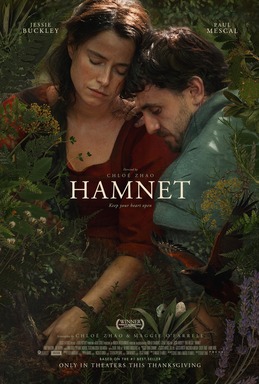
The Oscar-nominated and Golden Globe-awarded Hamnet is causing some contentiousness (okay, that’s going too far) among my friends. Half of us watched the movie first and liked the movie better. The other half of us read the book first and are loyal to the book, Hamnet by Maggie O’Farrell. Hamnet was the first O’Farrell I had read a couple of years ago, and it was how I fell in love with her writing. I did read the book first, and I was looking forward to the movie, but found it hard to catch a viewing (which were sporadic around town); though let’s remember that I said—in my review of the book—“There is a movie version of Hamnet under production, apparently. I don’t know how I feel about this. It is such an interior and lyrical novel that I am having a hard time imagining how they can capture it in a movie. I guess we’ll see.”
Turns out I’m a prophet, at least for how I experienced the movie (and my friend and also my daughter, who hasn’t read the book at all). There are some really admirable things about the movie, like the sets, the cinematography, and for sure the acting. It feels real and like you are there. No anachronisms here. But I found it so stripped down, so bare, that it was boring. It leaned so heavily on the plot, and literary fiction is not about plot (almost all the time). Everything I loved about the book was missing in the movie. I suspected that one could never capture O’Farrell’s writing style in a movie (or wouldn’t, I guess), but in the interest of time, perhaps, it also omitted the interiority, the character development, and the multiple POVs. It was the opposite of “swooping,” which is what I called the book in my review, or “frantic,” which is what a less-enamored friend called the book. (To my face!) The total opposite. I cried, sure, but the emotional engagement was at a completely different level from that of the book because I wasn’t in these people’s heads.
I’ll give Chloe Zhao (the director) this: she made sense of the ending. I was not so enamored of the way the book ended (you’ll have to read my review for deets), but Zhao tidied it up and really slam-dunked it at the end. Of course, in order to do so, she had to give Shakespeare more of a spotlight and also give the ending more time on screen. I loved her ending, even though I find the idea—that Shakespeare was dealing with his grief through the writing of Hamlet—unlikely at best. It totally works in the setup Zhao gives it.
It’s not bad. You might love it. You might find it a little empty and/or boring. You’ll probably cry either way. If you’re watching the Oscar noms, then have at it. I would even recommend it when paired with the book, but it turns out (in my small, anecdotal bit of research) that the type of people who love the book don’t appreciate the style of the movie, and vice versa. That’s kinda goofy.
Note from later: It was fun–and inspiring–to see O’Farrell at the Oscars!
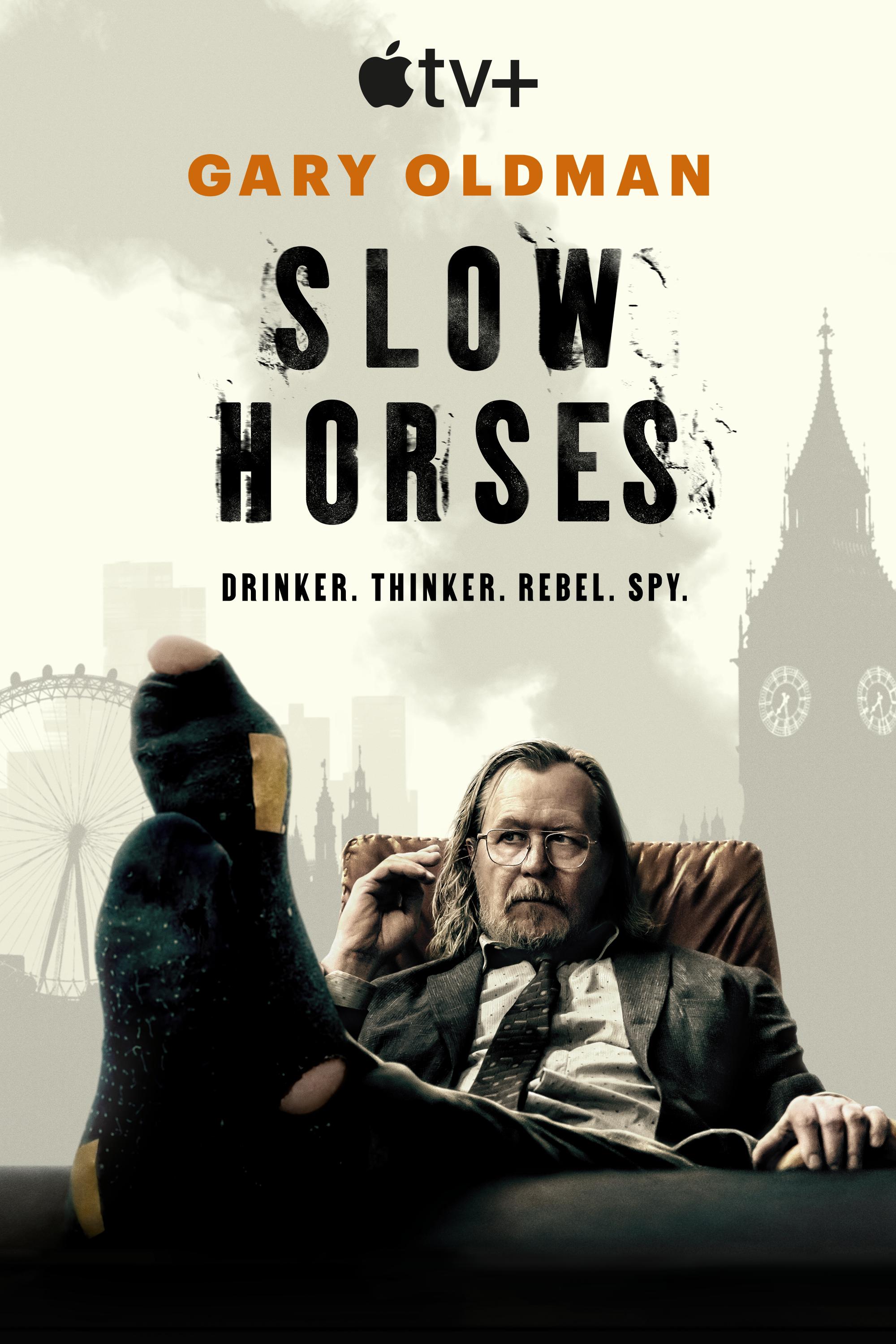
I have not read even one book of the Slough House spy series by Mick Herron. I am not under the impression that I need to, but if I were more into that genre, they are a sort of modern classic. Perhaps because of the streaming series, I don’t know. They’ve been around since the first one was published in 2010 and Herron is still writing them (and other books in the same universe).
They are:
- Slow Horses
- Dead Lions
- Real Tigers
- Spook Street
- London Rules
- Joe Country
- Slough House
- Bad Actors
- Clown Town
There are also four novellas (The List, The Marleybone Drop, The Catch, The Last Dead Letter) and a collection of short stories (Standing by the Wall) that are part of the series. And three novels in the same universe (Reconstruction, Nobody Walks, and The Secret Hours). Herron is a busy writer.
The streaming series started in 2022 on Apple TV and has an 8.3 on IMDB (that’s really high) and a 97% on Rotten Tomatoes (also really high). And lots of devoted fans. We are now five seasons in, with the show already renewed for the next two seasons. (I think season six is dropping in the fall, if I remember right?) The earlier seasons each cover a book (approximately).
I’m not a police procedural kind of gal, but I do give anything British a chance because I am an Anglophile. Part of that is that I consider British TV to be smarter with how they handle series. They go in; they do (all) they intended to; they get out. Slow Horses is more than just any ol’ TV show, however. The big draw? Gary Oldman. My husband—an actor—can’t say enough good things about Oldman’s acting. I would say he’s his favorite actor, but Kevin doesn’t like to play favorites. And yet, his character (the de facto leader of the cast-off division of MI5) is gross. Unlikeable. Awful. And yet… darned if you don’t root for him again and again. And he’s surrounded by eff-ups, including the main protagonist, River Cartwright, who is actually loveable (at least until season five. I hope we come back to that).
Each season plays like one big mystery-event/case/whatever that is solved by the end, and the characters have lives developing between seasons. Just like a normal spy series. I find that I am drawn between episodes by wondering what is going to happen, but the real draw is the acting and the irreverence of the show. I do need some sort of character I can root for to return for season six (because it’s more than Cartwright whose soft side disappeared for season five), but generally people seem to like this series more for the flawed-to-a-fault gang of misfits that is Slough House.
I recommend it. Especially if you like that kind of thing, but even if it isn’t normally your cup of tea.
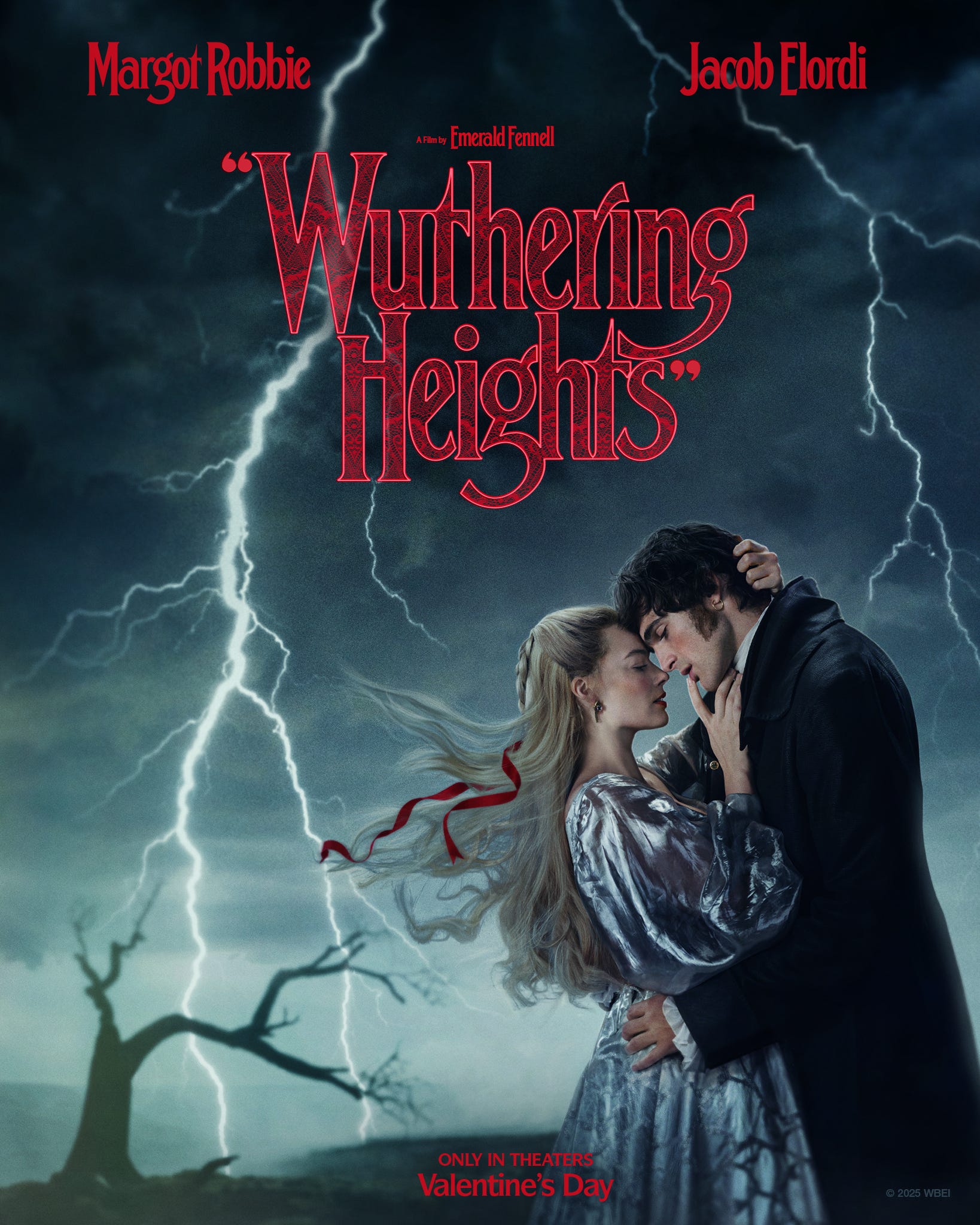
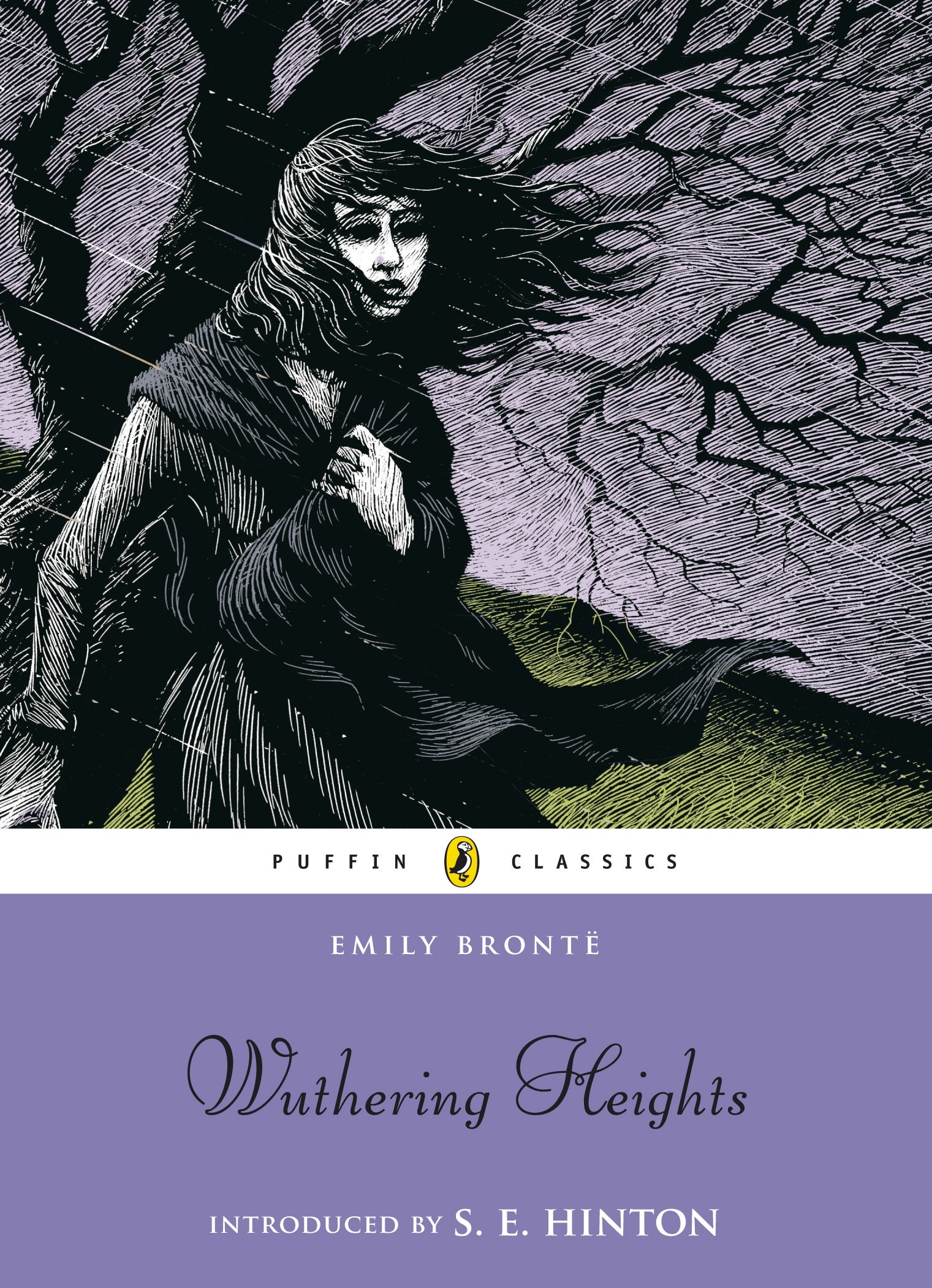
Wuthering Heights by Emily Bronte is not my favorite Bronte book. I appreciate it. I would even say I like it. But it’s not a fave. (How could I say that?!) After I read it, I watched as many adaptations of it as I could get my hands on. My main beef with every adaptation: they try to make Wuthering Heights a romance. To be fair, plenty of people read the original as a romance. They are wrong. (See review HERE.) Wuthering Heights is an anti-romance; it’s a story about wounded and broken people incapable of love. So I was concerned that the new Emerald Fennel version would do the same thing. I wasn’t wrong to be concerned. The ending sucks because it—yet again—interprets it is a romance. Heathcliff gets an ending he therefore does not deserve. But that was barely on my mind when I left the theater.
Because I wasn’t sure what I was thinking or feeling when I left (the sound of my friend laughing hysterically (and loudly) during several hard-hitting scenes still ringing in my ears). The movie is—over the top. Some of the scenes too over-the-top. I think. Probably no one in the theater should be laughing and that’s why it gets pretty dismal reviews. That, and the anachronistic things like plastic clothing. And yet… I can’t bring myself to hate it. I was certainly entertained. I found the acting to be impressive, the sets and costuming… um… fascinating. I was riveted. Also grossed out. Also rolling my eyes. Also continually curious.
The thing about this adaptation of Wuthering Heights is that it is more a mood than anything else. Sure, the basic story (and some specific scenes) of the first generation of the book is there. But everything else about the book is interpreted visually, with our emotions more than with some sort of historically accurate reproduction. I mean, we have walls made of skin (sort of), wings made of leeches, doll houses filled with voodoo dolls, BDSM… it is a stretch, but an artistic, intentional stretch with tight (uncomfortable tight) cinematography. I can’t help but wonder if Fennell meant to take it past the breaking point (which, according to most critics, she does). Shouldn’t we have expected that from the early scene with boulders clearly made of plaster? Someone who appreciates French and Korean cinema, with all their grit, nihilism, and body horror, is going to appreciate this film much more than just any ol’ literature buff. All day, every day.
I can’t bring myself to hate it, actually. I thought the portrayal of Isabella—while completely ridiculous given what’s written—was funny and playful and well-acted. Super-annoyed by the last several minutes. But until then I was cringing, I was gaping, I was tilting my head sideways and wringing my hands at every close-up of snail slime and fingers slid into aspic. And that might just have been Fennel’s goal.


 the starving artist