Yes, I know it’s now March 1. Hush.
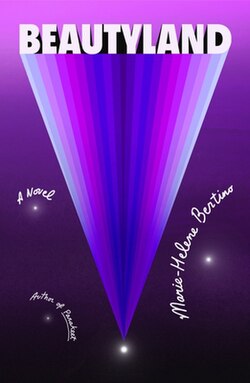

I had been looking forward to Beautyland by Marie-Helene Bertino, another one of those lauded, literary sci-fi reads like The Ministry of Time (which it turned out I didn’t love). Where did I land on this one? I don’t know. I feel torn. I liked it. It was a little disappointing. Did I know what I was getting into? Not exactly. Because this book is a lot of things I love (80s and 90s coming-of-age, magical realism/speculative fiction, literary-bent, quirky characters, a dog…) and it was SO nostalgic. But it was also, well, maybe too literary in the end without wholly reading literary. I don’t know if that made sense.
Blurb: Adina doesn’t fit in. Is it because she’s kinda weird? Precocious? Alone? Or is it because she’s an alien sent to Earth to scope things out and report back by fax machine? Beautyland is a coming-of-age story that feels like a poetic biography full of nostalgia and surprises. Adina sends dispatches to outer space. A friend encourages her to publish them. But what for? And will anyone believe she is really an alien before she’s whisked away off the planet and away from everything she’s ever known?
I find the beginnings of books (or series) to be the most difficult. Every author’s style and each world takes work to adjust to. Beautyland was one of those books where I barely understood what I was reading at first. I probably should have gone back and re-read the beginning once I got my bearings, but in my defense, there are no chapters, just giant sections which are eras of Adina’s life, so I had to breaking point, few bearings. This never fails to overwhelm me a bit. I much prefer longish chapters with chapter breaks, not one enormous narration or small vignettes. (This book is also present tense and bundled into short, choppy sections.) So, I may have missed a little at the beginning in the literary/baby- and child-perspective of it all. Which means I didn’t go into the story with a clear understanding or much encouragement. But I went.
The plot and stakes were more literary than science fiction. (Don’t let anyone convince you this book is speculative. It is not.) In other words, there isn’t much of a plot or stakes. I could have put it down at any time and said, in the words of a fellow book club member, “That was a nice read.” I was enjoying the nostalgia that I mentioned—Adina was born in 1977 and I was born in 1979, which meant Bertino’s many, many references to the real pop culture and history of the 80s and 90s, etc. were super fun for me. The writing is a bit out-of-touch, like Bertino is trying too hard (aren’t we all?), when frequently I just wanted to know what just happened or what the characters are like. (The characters are viewed very obliquely, all but Adina, but she’s still obscured some by the language. For example, about two-thirds of the way through Adina is described as “funny,” and I was baffled by this. I didn’t get funny from her at all.) And to top it off, there were so many cute asides that were clearly some sort of insight/wisdom, but my worldview is clearly very different from Bertino’s, so — we were missing each other in a lot of those moments.
It was like reading two books at once—narrative fiction and an allegory. What I mean is, the reader is left to decide along the way whether Adina is really an alien or not, and in the end that conclusion doesn’t even totally matter because the reader is aware all along that Adina’s alienness is an allegory for her being “alien” and feeling “alien” in her world. And then we’re back in the room with books like Eleanor Oliphant Is Completely Fine, finding neurodivergence—specifically autism—in a book where the author denies it. But come on. I felt seen as neurodivergent in this book, especially since Adina has misophonia, which I also have. But when you make these things into an allegorical alienness, it feels right, but is in counterproductive? Is it offensive, even? Which might go double for the asexuality in the book.
It’s also one of those books where I expected and wanted a big, over-the-top ending to go with the quirky style, but this is not what we get. (I wasn’t the only one wanting this, but plenty of people are always happy with a more literary petering out.) I would argue Beautyland really warrants a big ending a la the indie movies of the early twenty-first century. Or White Teeth.
I liked it. I didn’t love it. I felt it had more potential than actuality. Don’t regret reading it.
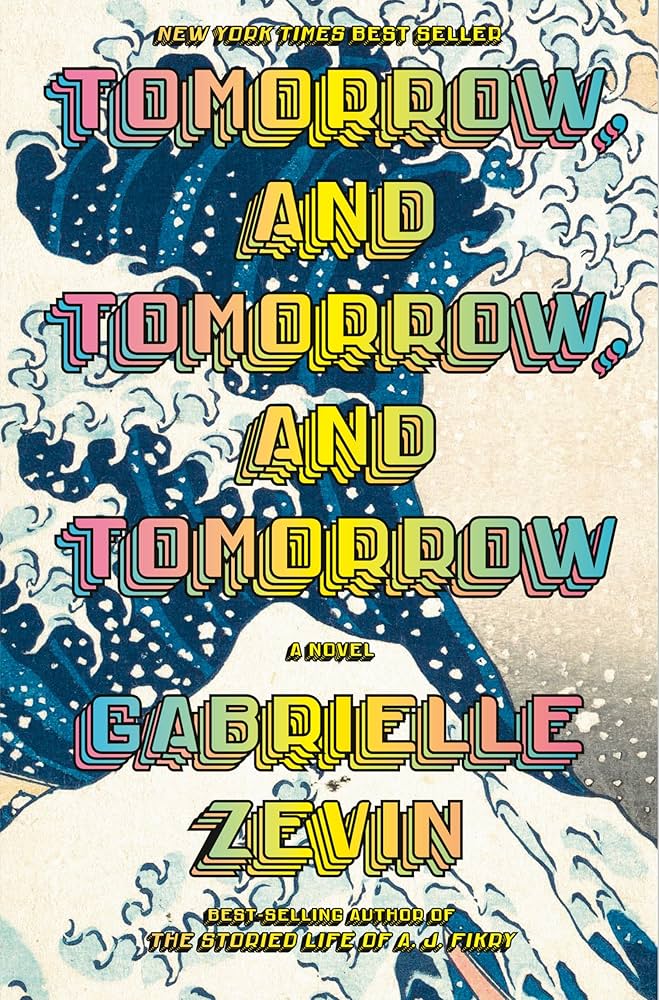

Now, Tomorrow, and Tomorrow, and Tomorrow by Gabrielle Zevin I probably could have done without. Don’t worry, there are so many people who adore this book that my bad-mouthing it won’t matter much. And it shouldn’t. I get it, for those people. Fine.
It’s a long book, too, especially for what it is.
Blurb: Sam and Sadie met when they were kids in the orbit of an LA hospital. But their relationship is never simple, and their secrets build barriers that they can’t quite get past. And yet fate is never done with them—two colleagues and fellow-geniuses in the world of game design. They pull back into each other’s orbits again and again in a decades-long story of hurt people searching for safe harbor in the gaming world of the 80s, 90s, and naughts.
Yes, Tomorrow is set in the same time period (just a few years earlier) as Beautyland, with these characters circling around Adina and her story throughout. It was kinda fun to read them one right after the other because it almost felt like the same world (mine) and a lot of the same nostalgia. However, Tomorrow is overlaid with a very 2020’s voice and modern sensibilities, which to me felt forced and pulled me out of the world. Zevin almost has these asides (as a narrator) where she tries to distance herself or her characters from the authentic experiences and culture of whatever historical period, like she’s afraid to present the times without a footnote that says, “But I’m not like that!” I find this pretty common in modern books. It exasperates me. By setting a filter over all our depictions of other times (from ancient Greece to the Regency), we’re making our own literature of-a-time, sort of ridiculous and indecipherable to future generations. Or so I fear. Sure, we all have filters on history. Of course. But virtue signaling while writing is obnoxious and unnecessary. Except it’s not. Because our current climate is fraught. Yeah, yeah.
Here is why I didn’t really like the book: I found the dialogue stilted and robotic. (Zevin shines as a writer in the non-dialogue writing, which flows very well and is easy to read.) The sudden, overblown vocab came across as strange, distracting (to more than one person in book club.) A twist isn’t really a twist unless it involves the stakes. So maybe we should say this book has “surprises,” but I did want twists to work as twists. Like in Beautyland, I lost the author on a lot of the “points” as the book went along. And Zevin calls a headache a migraine at one point. That will always get my knickers in a twist.
But the real two things that worked against me in this book are the characters and the main plot device. By page 125, I no longer liked these people and no longer cared about where they ended up. (I can be okay with some unlikeable characters, but with the lack of conventional plot and all the many, many words, I also found them uninteresting eventually.) Quite frankly, I was no longer invested in their happy ending. I felt icky around them; they were not just broken, but self-centered and hopeless. I’m way over books without a north star (which I have said before). And as far as that plot device, this is my short version of this book: two people can’t seem to open their mouths and say the truth. Ever. The end. For me, a lack of honesty and self-built houses-of-lies as a main conflict do not work to compel me. In fact, I find them unenjoyable to read (or watch). Across the board.
What people—and even I—like about this book includes all the gaming shoptalk that speaks even to the least gamer among us. As a fellow reader said, it’s like reading historical fiction, and I listened as lots of older readers claimed they learned a lot and liked it. (So many people love this book.) Some of them even gained an appreciation for a world they had been wonted to despise. I enjoyed being immersed in the world for my son’s sake. There were some really cool game ideas, too. (I did have one gamer friend who said Zevin got it all wrong with the game-world stuff, but I don’t see too many people saying that.) I agree with Zevin emphatically that a great love story can be a great friendship story—so emphatically—but I didn’t find Tomorrow to be either. There was a lot of circling, not much (if any) growth. And to quote two fellow book clubbers, “[Sam and Sadie] were sort of unevolved,” and “This is a 400-page novel that has a good 200-page novel inside it.” Because there are some impressive scenes. And some fun structure choices.
While I’d been looking forward to this book (which, because of the title and cover, I sincerely thought was time-travel sci-fi—it’s not), I failed to notice that I had read this author before. I was not impressed with The Storied Life of A. J. Fikry either, even though that too gets lots of love from the average reader. Maybe it’s better I didn’t notice. Because now I know I am just not into the flavor that is Zevin. You can be. Meanwhile, I’ve got plenty of other authors to read.
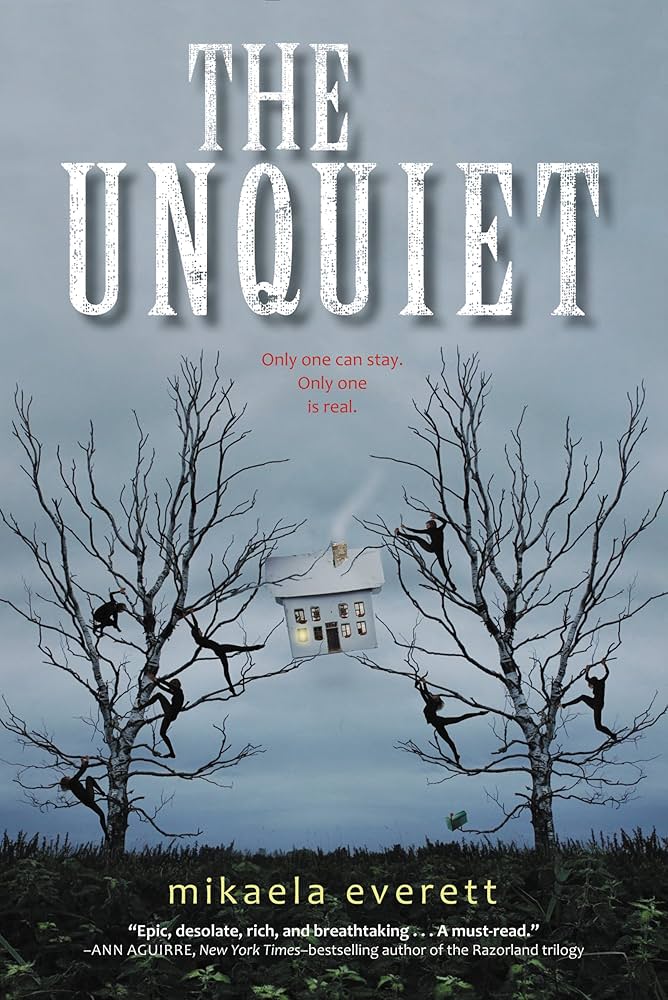
This book came out of left field. Never heard of it. And it was hard to find. Mikaela Everett has one novel, and that is The Unquiet. It kinda looks like that will be it for her. It was not particularly popular, either. But somehow it landed on our YA book club schedule. So, I ordered it. I verified it was the correct The Unquiet. It took some doing. And then I read it. I was not entirely disappointed.
Blurb: Lirael has been sent to Earth 2 to train as a sleeper soldier, and she doesn’t have—has never had—a choice about it. She was chosen to be a cold-blooded killer at the ripe old age of teenager, when she’ll be dropped into the life of her doppelganger and forced to live in secret until the war for the worlds begins.
The Unquiet takes place in France and is written by a Canadian who is something like a citizen of the world. While I agree with some of my book club friends that it could have taken place anywhere and wasn’t firmly rooted in France (or in time), I think that the soul of the book—the tone, the story—is quite French. You know, chill and full of existential dread and philosophical moments, very interior (even for YA), nihilistic, melancholy, dark, and lacking hope. At least for YA. And yet it’s not brutal. That’s what I liked about it. It wasn’t really meant to world-build; it was very Never Let Me Go but probably less genius.
There was a blankness to the tone and the descriptions, the latter which sometimes happens in YA because of the closeness to the MC. There is almost no description and lots of telling. Is this okay? I love setting, truly, but I didn’t need much more than what Everett gave us here, but I did need more. It was kinda magical sci-fi/horror with a traumatized and flawed hero. People like to pull out the ol’ “unreliable narrator” schtick for so many books, including this one, but that’s not what’s happening here. The characters (mainly just Lirael) were complicated and growing, so not everything we hear in her head is objective truth. People deal with denial. Etc.
The big idea here is either trauma or colonialism. Maybe both. I enjoyed reading Unquiet. It felt like a breeze moving in a different direction from a lot of what I read. I wouldn’t mind trying another Everett book as she develops as an author, but like I said, I’m pretty convinced there will not be another one.
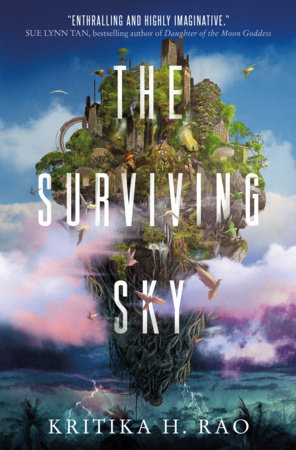

I am all aboard for this trend of middle-aged main characters, and so was excited to dive into Kritika H. Rao’s The Surviving Sky despite being made reluctant by the title.
Blurb: Ahilya just wants to spend every moment her flying city is on the ground exploring the storm-racked jungle, but she’s not an architect and she doesn’t have a lot of say in things. The architect would be her husband, Iravan, and she hasn’t spoken to him in seven months. And maybe the jungle is less-hospitable these days. Maybe there are new dangers emerging in their world. Maybe the architects won’t be able to keep the cities air-born forever. Maybe their broken marriage is the one thing that can.
In their 30s and dealing with marriage problems while saving a fantastical, air-born, Indian-esque world? Yes! But in the end? Not so much. Poo. I have not had a great reading month—my year so far has been mediocre. Maybe in February? (Spoiler alert: my reading finally picked up mid-late-February.)
I have to say that though I found some real problems with this book that kept me from sinking into it or really enjoying it, my problems were not some of the youngsters’ problems. I did not find Ahilya and Iravan or their marriage issues tedious, and I for sure didn’t want them to “find a therapy tree.” Another spoiler alert: there is no magic therapy wand in life and shouldn’t be in fiction. Yes, their characters and the plot felt murky and could have used a lot of fleshing out with way less words in the book, but that was a writing issue, not a relationship issue. I liked the characters fine. If they would just stop trembling. (There is an inordinate amount of trembling in this book.) Of course, I do hate it when people won’t just talk to one another…
The real issue in this otherwise compelling and fascinating world was a lack of “normal” life and/or tender moments between the MCs. Despite the middle-aged people and the fascinating Eastern thought and religion as a base for the fantastical world (including blue people and releasing material bonds at a higher level of consciousness). So with things missing, how was it so long (521 pages!)? Too much telling. Repetition. And I am a setting person as opposed to a world-building person, so I could have used a clearer visual of the spaces.
As much as I hate to admit it, another book club friend might be right: different characters in this same world might have been a better choice. No. Nevermind. I don’t agree. I think these two should have worked with different writing. Then other characters could have been developed in later books. (Also, the ending was faily universally hated. I’m… in the middle.)
I’m not going to go on to the rest of the Rages series (The Unrelenting Earth, The Enduring Universe). There was some good here, some not-so-good. I fall somewhere in the middle in my opinion, but am not interested enough (I think) to keep going.
But I will keep reading.


 the starving artist