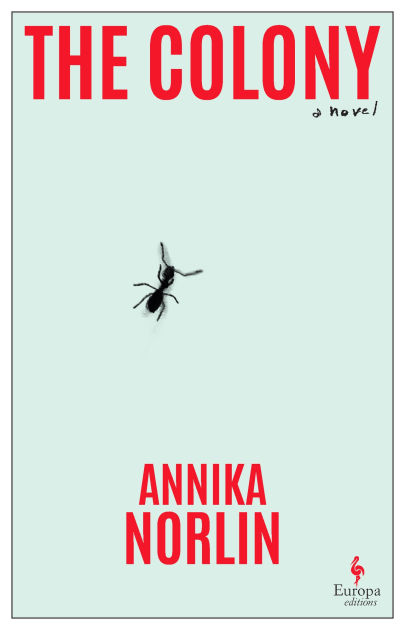
This book came out of left field, but I am so glad it did. I am in this one book club (out of seven) that reads kinda whatever these two guys (okay, they own the bookstore) choose, at least most months. They don’t reveal the next month’s read until everyone is sitting around discussing the previous read. Then they unveil it. I have to reject books that I don’t want to or don’t think I will read, due to over-ARC-ing and over-TBR-ing. When they unveiled this one, I was lost. Did I want to read The Colony by Annika Norlin. How the heck would I know? And the blurb had me ambivalent, the size of the book reticent. But I bought it. I took it home and started to read.
Blurb: Emelie is burned out. She flees the city for the forest of small-town Sweden. But she’s not as alone as she expected, and she finds herself increasingly curious about the band of random people who inhabit the woods where she landed. And what a band of random people they are…
The Colony is a translation (and a very good translation, as far as I can tell). It is a big deal in Sweden, where it was written and first published, and has made its way to other places as a best-seller. (They’re calling it the biggest literary sensation in Sweden since Backman’s A Man Called Ove). They are supposedly making it into a show, and it won some awards, like the Vi Literature Award and Swedish Radio’s Novel Prize. I don’t want to talk it up too much, but when you come at it like I did—with no expectations—it is a real fun ride, a (somewhat creepy) delight around nearly every corner.
The New Yorker says that Norlin “has a wonderfully unpredictable way of writing. It’s both journalistic and poetic, and she moves back and forth between the registers in a way that few writers can. She leans toward the reportorial, but there are beautiful sentences hidden throughout, and when you find one it just knocks you over.” I concur. Norlin’s a musician, by the way. This is her only novel. Hopefully only her first of however many.
The Colony is several things. It’s satire about modern life. It’s about cults (though you could argue and say it’s about people living in community off the grid). It’s a multi-POV dark comedy. It’s a character study (about characters and also about the collective) with some sad twists and turns. The structure is unique, the writing style pretty enough to call it literary, yet still accessible. Sometimes the line breaks get a little poetic. Sometimes the author (or maybe the translator) uses three exclamation points in a row (!!!). I loved it all. And in the book club, everyone seemed to at least like it okay, which is pretty special.
Some complained it dragged in the middle. I wouldn’t really know because I had lots of life-distractions to slow me down, either way. My only real problem was the way it was broken into sections—I found it distracting because it was unnecessary, and in some ways nonsensical and confusing. But this complaint springs from something else: even without the labels all over the place, the transitions between multiple POVs and time and tenses were seamless. You rarely find that. It’s a great way to tell this story, simple as that. (Have I ever seen second person work this well?)
My notes: tension; slow burn; surprises, but literary; the characters!; complex without giving their whole life story; distinct; real; fascinating.
And that ending.
Plus, when you are done, you’ll want to chat it through with a friend. So, a great book club read. Is it a cult? How is a cult leader made? What about that one magical realism component? Or was it just a metaphor? And you’ll have lots to say about the characters. It’s the characters that really shine here. They are clear as glass. Actually, I found setting and plot to be clear, as well.
I don’t know that the cover is doing it any favors. It’s not bad, but it isn’t really selling what’s going on inside. It should probably have been a lot more, um, psychedelic. Here are two covers from other places:
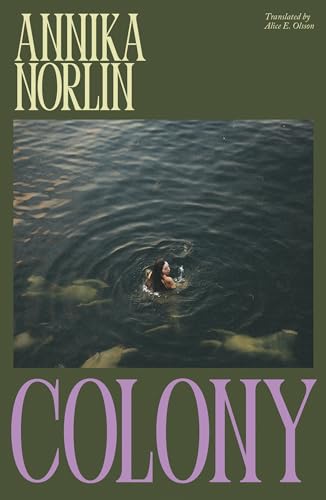

Would I recommend it? Of course. I wish it were on more people’s radar. It’s one of my top reads of the year. (It was published in the US in March.) I fear I have talked it up too much, but that doesn’t change my mind about wanting you to pick it up.
Note: the books and authors mentioned (that I noticed, at least): Arne Naess, Henry David Thoreau, The Girl with the Dragon Tattoo (Stieg Larsson), Hash (Torgny Lindgren), Jackie Collins.
Another note: content warning, especially regarding sexual assault.
Last note: Some book club friends recommended The Banshees of Inisherin (Martin McDonough) and Birnam Wood (Eleanor Catton) as companion reads.
“My friends longed to have children, to meet someone, but I always felt that the more you let people in, the greater the risk that they would ruin things” (p18).
“Unfortunately, I don’t feel that my pasta puttanesca adequately compensates for the state’s betrayal” (p23).
“You stand in the middle of the bus and cry. At first, you lower your head, hoping no one sees—it’s so embarrassing— / but then you realized that everyone is just staring at their phone, so you didn’t need to worry about it” (p24).
“…she said that distracting oneself from the Outdoors is like refusing to be in your own body. Well, I would do that too, if I could” (p27).
“…it was like they were washing each other without any concept of time, of it being scarce and there always being other things to do. As if they did it without expecting anything in return” (p29).
“Those who greet the weather with acceptance are spared a lot of grief” (p51).
“Ants were born with different tasks. There was the queen, the workers, the drones. They didn’t have to be everything all at once. Sagne longed for this, to be included without being questioned” (p128).
“If it was out there for you, maybe it’s out there for us too” (p134).
“When that goes away. The person who thinks you are the most important thing that exists. What that does to a person” (p144).
“Sex can be as many things as a conversation. A game. A bandage. A shrug. A party. Yoga? Violence. Something purely physical, almost like exercise. Bragging. People seeing each other. One seeing the other. If you are lucky: a bond” (p147).
“No one talks about the currency of a really good giggle” (p165).
“The body needed to do certain things, and it was mostly humanity’s own fault that in our minds we had turned it into something disgusting” (p197).
“If you had seen from the beginning which was things would go, you would have pumped the brakes from the start. But one day turns into the next and, without much thought, it becomes a life” (p210).
“I believe that if one person hurts another, you have to assume that it’s the first person who deserves pity—that they just don’t get it. Revenge only means digging a deeper hole, not letting go. You won’t feel better because someone else feels worse” (p231).
“They walked around with questions in their eyes—questions they let the others in the group answer, and the others always answered that what they did, the way they did it, was meaningful. The same way all people in all societies do. You look at one another and see others doing the same things in the same way and you think ah, this seems to be the way of existing” (p278).
“And thus fell the verdict, light as spring rain, regarding Lake’s future, it fell over the dining table on a night in February” (p281).
“…singing wasn’t a destination bit a constant doing, an action for the body to perform, just like sleeping or eating, and surely no one would tell another that they slept in an improper way?” (p285).
“There was so much forest he used to think of as just regular forest. Here I am, walking around in the regular forest. But this regular forest had turned out to be tree plantations” (p317).
“Everyone has three personalities, minimum. One in real life. One on the internet. And one when you are drunk” (p336).
“…who is truly the loneliest, someone who lives far out in the middle of nowhere but is lumped together with people, or someone who interacts with hundreds of people every day but refuses to let anyone under their skin?” (p338).
“As human beings, we make so many small choices every day that we forget we also have the ability to make big choices” (p344).
“We carry on with our little lives, whoever we are. There’s no logic to it. We have no clue. We reach our hands up in the air and when something flies by that feels right we grab on to it. That’s what humans do” (p348).
“It’s remarkable how long a person can dither” (p381).


 the starving artist