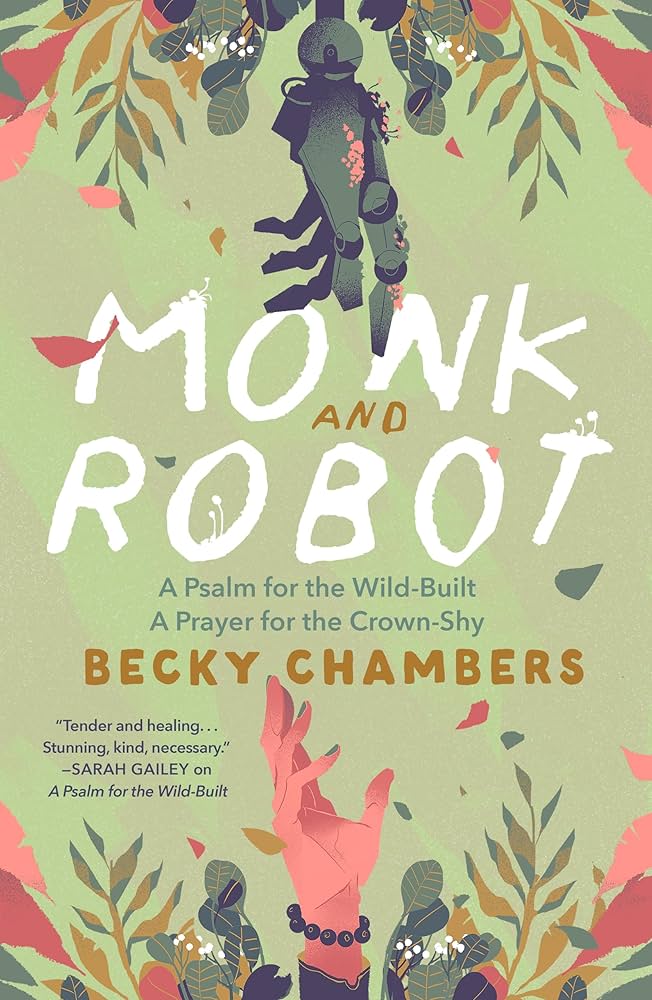
Series review, which is also a book review.
Yes, Monk and Robot is a series. It is also a book, but let’s give that italics: Monk and Robot, by Becky Chambers. You see, the two books of the Monk and Robot series—Psalm for the Wild-Built and Prayer for the Crown-Shy—are novellas and, like the Murderbot series, are being gathered together in more normal-sized chunks and carried in bookstores everywhere (at a more palatable size for the price point). However, Monk and Robot is complete as a series, just two books in one and done. The thing is, after reading it/them (that’s unintentionally funny and you’ll see why in a minute), I realized I would have been fine reading Psalm for the Wild-Built and calling it a day. But I wouldn’t have known that ahead of time. And I admit I would have balked at buying the slim original (like Nghi Vo or Claire Keegan, all hardcover to boot!).
Summary: Sibling Dex of the City suddenly wants a change of scenery and assignment, wandering off into the woods to become a traveling tea monk. But just when things are falling into a peaceful rhythm, the restlessness comes again, this time along with a run-in with the first robot seen by humans in centuries. Mosscap is on a mission: to make first-contact and ask humans what they need.
I find that I can’t continue the synopsis with some tantalizing hook or question, because the point of this book is being cozy. Like seriously cozy. I have looked it up and found people calling it hopepunk (like steampunk but in a hopeful future), solar punk (so solar hopepunk?), and cozy sci fi. You could even call it cozy Utopian post-apocalyptic, I suppose.
To be frank, I did not know that a book or a reading-experience like this existed. A new one, for me. I love being surprised. Pleasantly.
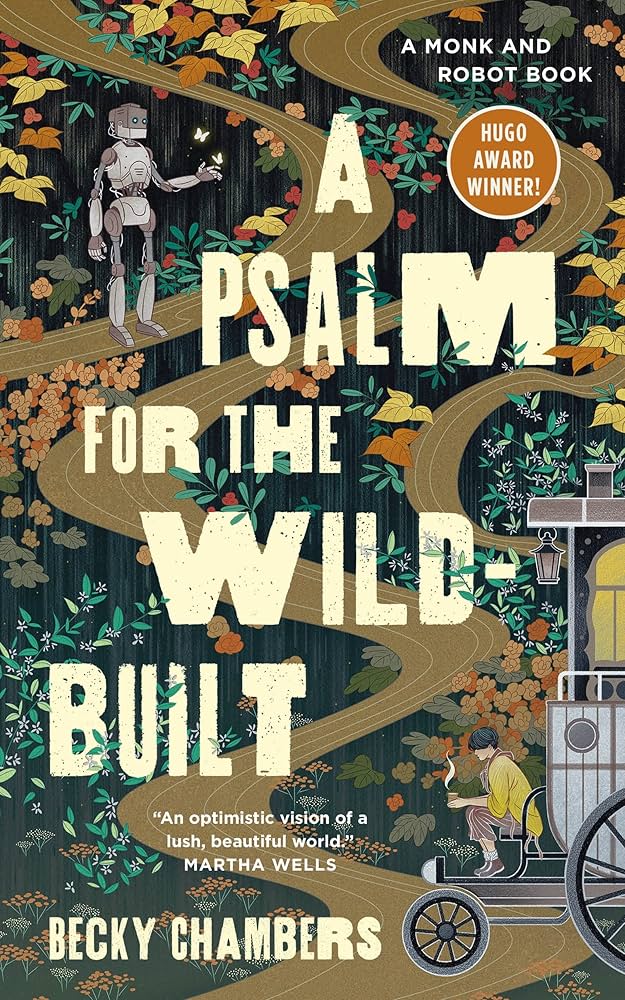
Psalm for the Wild-Built: I found this book to be so interesting, and if it weren’t for the very progressive worldview, I would wonder why it wasn’t assigned reading in all the high schools. It would make for an entertaining, relevant, readable, and yet highly parse-able and discuss-able text. It reminds me of Brave New World or The Scarlet Letter, but a lot more updated and much chiller. It’s a brief book (even containing two novellas), and the writing is powerful even though it is also seriously calm. I had so many thoughts related to this version of our future and the world-building. That’s kind of the point. Writing style also pretty on-point.
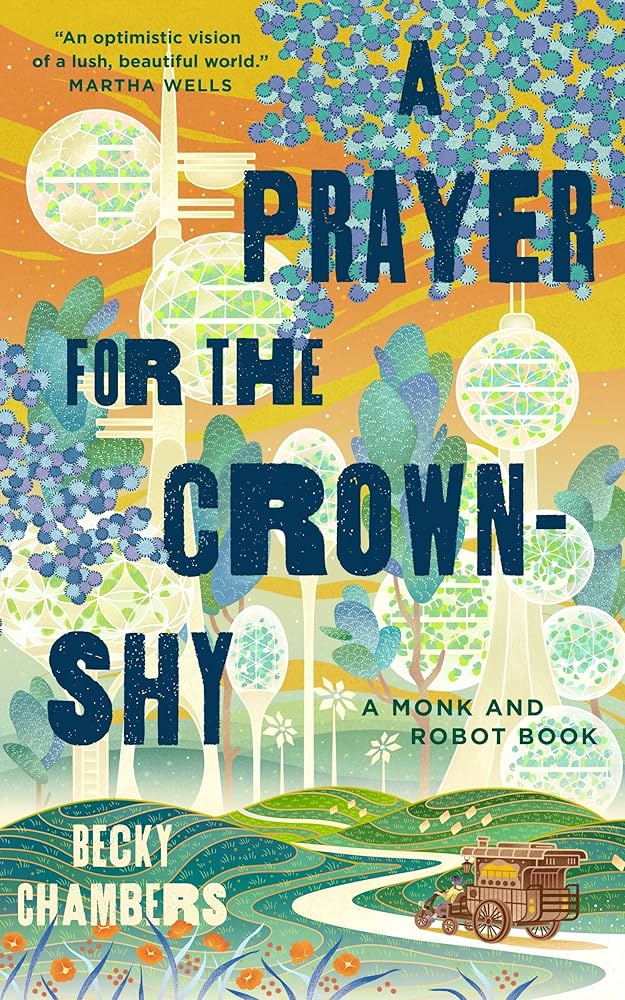
Prayer for the Crown-Shy: It’s not bad or anything, but it seems to me that only superfans would need this. I got wherever I needed to go with this story and with the thoughts in the first book. The second is an extension, even calmer, less of a story, even cozier. It spells a lot of stuff out that I was happy to wonder about and extrapolate in the first book. And I already said it, but the second one doesn’t really have much of a narrative draw-through. The first one wasn’t tense or mysterious, really (which is the point of a cozy), but the second one had almost no story-related questions.
And though I enjoyed this book/series, was happy I had read it, appreciated it, and will happily recommend it, there is a lot of stuff conceptually that I am just not on board for. I was like, “Yeah, right. As if.” Then again, maybe it won’t hurt to suspend reality in these ways (like regarding our future and in the way humanity works, its very nature, not to mention our relationship to the gods/God) like we do for, say, magic or fantastical creatures. We could all use a reality break, amiright? I just feel like plenty of people reading this are going to believe in the actual ideas, and that’s fine for them. Just not for me.
The themes include: AI, sentience/intelligence, identity fluidity, humanity and human behavior, environment/nature, and coming-of-age. Part of my disconnect was the lack of distinction between sentience/intelligence/personhood. I mean, Chambers does discuss it some (and imply or skirt around it a lot more), but not in a way I found real or satisfying. Others will be fine with it, I’m sure, having a different worldview from mine. But I do think it’s super important to make these distinctions and definitions considering where we are currently with AI and “robots.”
So that’s a pretty simple review, considering my track record. I enjoyed it. It made me think. I was not fully on-board with what it said about humanity, but it accomplished what it means to (be cozy and hopeful) and more (beautiful language, endearing characters). It would make a great high school read, but is appropriate across the ages (except kids). I would highly recommend this book for many readers. It’s an easy read, but a thoughtful and pleasant one with both clear and descriptive writing and most people will enjoy it. (The first also won the Hugo.) It would make a cool graphic novel and possibly a cool movie.
Oh, and the reason my them/it comment was funny (referring to the novellas and the book) is that the main character in Monk and Robot identifies as they/them (which I actually found useful here, making this future human more universal). The robot identifies as it, because it is an object, not a person, which is all part of the conversation with this book.
Note: I really like this cover, but I liked the old covers even more.
“A forest floor, the Woodland villagers knew, is a living thing. Vast civilizations lay within the mosaic of dirt: hymenopteran labyrinths, rodential panic rooms, life-giving airways sculpted by the traffic of worms, hopeful spiders’ hunting cabins, crash pads for nomadic beetles, trees shyly locking toes with one another. It was here that you’d find the resourcefulness of rot…” (p30).
“Dex had never thought about it like that. ‘You’re right,’ they said. ‘I’m sorry.’ / ‘Don’t be. This is an exchange, remember? These things will happen’” (p74).
“That’s how we function, not how we perceive” (p79).
“’I am made of metal and numbers, you are made of water and genes. But we are each something more than that’” (p80).
“’Every living thing causes damage to others, Sibling Dex. You’d all starve otherwise’” (p89).
“Its only legacy was to persist where it did not belong” (p94).
“If the originals had simply fixed themselves, they’d be behaving in opposition to the very thing they desperately sought to understand. The thing we’re still trying to understand” (p98).
“It’s very odd, isn’t it? The thing every being fears most is the only thing that’s for certain” (p98).
“The ecosystem required the elk to be afraid in order to stay in balance. But elk don’t want to be afraid. Fear is miserable, as is pain. As is hunger. Every animal is hardwired to do absolutely anything to stop those feelings as fast as possible. We’re all just trying to be comfortable, and well-fed, and unafraid” (p99).
“I think there’s something beautiful about being lucky enough to witness a thing on its way out” (p102).
“…the bulk of what they found was anger, constantly doubling itself like cells dividing” (p114).
“That’s something I’m doing. That’s not my reason for being” (p141).
“…it is enough to exist in the world and marvel at it. You don’t need to justify that, or earn it. You are allowed to just live” (p141).
“Do you not find consciousness alone to be the most exhilarating thing?” (p142).
“…’how does the idea of maybe being meaningless sit well with you?’ / Mosscap considered. ‘Because I know that no matter what, I’m wonderful…’” (p143).
“But that’s the point of a shrine, or an idol, or a festival. The gods don’t care, Those things remind us to stop getting lost in everyday bullshit” (p166).
“On the contrary, our way of life shows you how comfortable the world is on its own. Paring things down makes the small comforts all the sweeter” (p248).
“Elsewhere, they have all these little luxuries, but they don’t understand that food and shelter and company are all you really need” (p248).
“They were the one who’d stepped in and decided that it was time for something’s life to be over because they were hungry and theory own life required it. Mosscap was right to look as unflinchingly as it did. Dex was ashamed that they hadn’t before” (p250).


 the starving artist