Halfway through The Great Believers by Rebecca Makkai, I was already confident that I was going to like it enough to recommend it. I trusted the voice and was so impressed that even if the ending was not satisfactory, there was still much to praise. I put it on my best reads of February blog, even though I was still reading it a few days into March. Of course, then I finished. And I still appreciate the same things about it that I did before finishing: the engaging writing; the complex and likable characters; the fascinating history, the realism; the clear, clean, sometimes beautiful writing. Even though multi-perspective books are a little overdone—and it could be argued this book didn’t need the second POV—I was fine with moving back and forth between a current plotline and a past plotline. And yes, it did lag some, could probably have been cut down. I was even sometimes confused who certain people were because there were so many. But I had no problem devouring it and enjoying it as a read (despite its brutality as a subject).
Yale Tishman is gay in the 80s; even more—he’s in Boystown in Chicago and it’s 1985 and he’s headed to the first of his best friends’ funerals, the brother of Fiona. Fiona has given him a tip that he follows to her grand-aunt, a woman who was embedded in the Paris art scene in the 1920s and is looking to donate art work upon her death. Yale works as a development director of a new art gallery for Northwestern: the two are connected, but Fiona’s family is unhappy, as are other people involved in the machinery of such a transaction. But does Yale have the time, the capacity for dealing with this amazing, career-making discovery when AIDs is moving like a thief in the night, picking off his friends and leaving carnage in its wake, creeping ever closer to his own bed? In 2015, Fiona is in Paris, searching for her estranged daughter, a daughter with deep connections to those happy and disastrous days of Boystown. Fiona is confronted by the ghosts of her past in her efforts to find Claire. Can she decode the long, long ripples from the 80s to understand where she can go next—and what collateral damage has continued?
Rebecca Makkai is a name I had been hearing in writing circles since Music for Wartime, her 2015 collection of short stories. After The Great Believers in 2018, the occurrences of her name only grew more emphatic and more frequent. By the time she published I Have Some Questions for You in 2023, the book world was definitely paying attention, and despite it getting reviews inferior to both Wartime and Believers, it was promoted very widely and given plenty of “best books of the year” statuses. I guess that’s often how writers’ careers go. So before I went to a Makkai reading for the paperback version of Questions, I read Believers on the recommendation of a friend (instead of waiting for Questions). I am glad I did. I am still going to read Questions, but we’ll see. I should definitely also get to Wartime, though it’s bound to be less popular because most people don’t read short story collections. I read and write short stories.
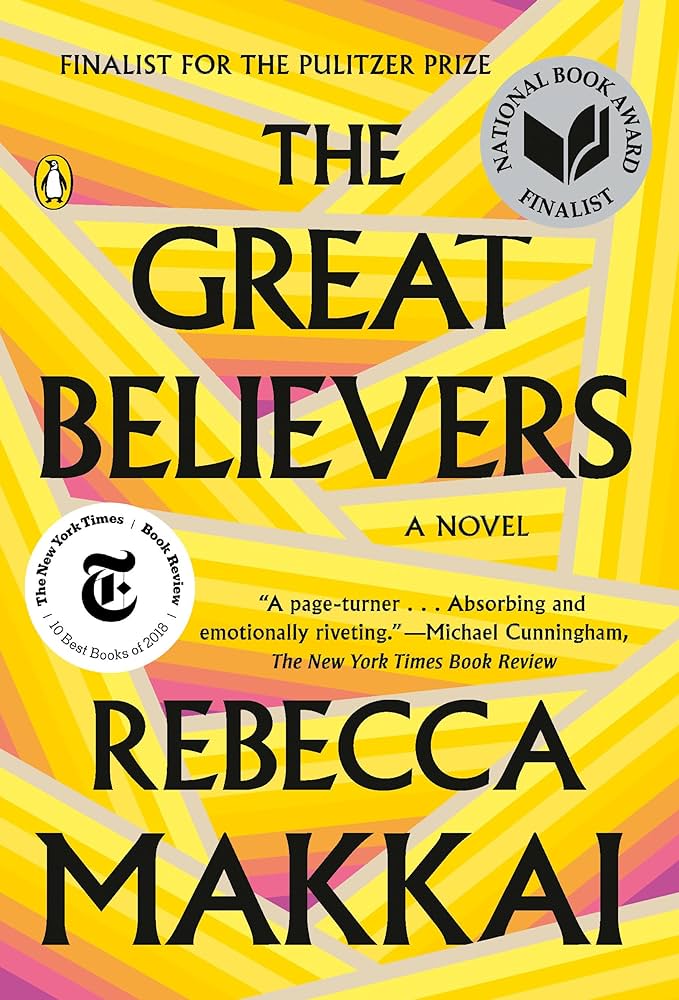
I love the cover of The Great Believers, artistically speaking, though I find it forgettable. It’s the title that I really find lackluster, however. The Great Believers. I Have Some Questions for You. Sorry, but Makkai’s earlier books had much catchier and easy-to-remember titles. I still hesitate before saying either of these ones, because they’re just phrases, and phrases without anchoring. I’m not even sure where the title The Great Believers comes from. I mean, I can assume, but it’s not very obvious. But we’ve moved past that—people are still hawking them and talking about them all over the book internet, magazines, and podcast world.
Reading about Boystown through the POV of sympathetic characters is rough. Yet Yale (and a few other characters) added levity just by being himself. He’s a wonderful character, well-drawn, and one that I won’t soon forget. My heart was much more in the chapters from the 80s because of my interest in Yale, but wondering about him and worrying about him pulled me through the chapters from 2015. As a matter of fact, the historical aspects and content of the 1980s scenes were much more interesting to me than Paris in 2015, too. I have learned lately just how much I enjoy well-researched historical fiction and I was blown away by my immersion into a life that I had never even really imagined. I was there. And I cared. And I learned so much about the AIDs epidemic, specifically in this population. And I also heard echoes to the present, not just regarding sexual or gender identity (which is obvious) but also about disease and, ahem, epidemics/pandemics. About how we react as a society to all sorts of situations. About vilification, abandonment, fear, the making of monsters, about surviving…
Which leads me to a criticism that Makkai has received (from some) regarding this book. Makkai is not a gay man. She does not, as far as she has said, have a connection with the epidemic except for her love of and residence in Chicago. The criticism is, of course, that she should not be the one to write this story. Well, Makkai is interested in history. She was very interested in telling this story. And she has been glad that telling it has allowed other voices to come forward and tell it in their own ways. The thing is, writers don’t just write about their own experiences. That would be impossible and boring. We use our imaginations and, in some cases, spend years on research to speak for others and to speak to others. Or sometimes just entertain. This book seems tremendously respectful and well-done to me, and it definitely brought me a story I probably wouldn’t have heard another way. If you believe genders, ethnicities, and orientations (etc.—the list would be endless) always need to align for a story to be told, then you are going to critique this. And you’re going to find yourself quite limited. I suggest you rethink your assumptions about voice, sympathy, humanity, universality, and the talents and responsibilities of artists.
Like I already said, I really enjoyed reading this book. It did take maybe too long to tell it. And it is possible it would have worked just as well without the 2015 storyline—or with the second storyline actually being set in the 1920s with the grand-aunt (whose story is told in the background). Yale’s story was much more engaging than future-Fiona’s; I was on the edge of my seat wondering what would happen with Yale and to his friends. If future-Fiona’s story had been in a book by itself, it would have been disjointed and boring and basically lack a real plot. And in the end, I don’t think the past and present came together as well as they could have, probably should have. If they had been tied together better, then we would have left the book feeling like the 2015 moments were indispensable to our understanding of the book as a whole. This is not the case. The mysteries all hang in the 1980s and any surprises that really affect what happens in 2015 are revealed (or figured out) long before the ending. And are kinda fuzzy. We care about the 80s. We are invested in the 80s. The 80s are clearer and full of big, bold characters. 2015, not so much. The 1920s had more in common with the 1908s, more parallels.
It is kinda strange, actually, that the other time in the book is not the 20s. The characters all seem so interested in the stories from the 1920s. Or the three could have been woven together? Because I get what Makkai was trying to do, showing the psychological and relationship detritus of trauma. But we didn’t quite get there. For what it’s worth, I also found Claire to be an inadequate vessel for the truth she was supposed to be carrying. I didn’t like her one bit and I found her unbelievable as a character. Perhaps she was the big problem with the second story.
I love this book. It will be added to my runners-up list for favorites. I will not forget it, either. I highly recommend it—if you like historical stuff, especially. I learned. I was concerned. I read late into the night. Though it has some excess baggage that should have been cut, it is deserving of its awards and almost-awards (like National Book Award Finalist). And Yale will go down in the blogs as one of my favorite MCs.
Rebecca Makkai has a website HERE. Her books are:
- The Borrower (2011, novel)
- The Hundred-Year House (2014, novel)
- Music for Wartime (2015, short stories, high reviews, high sales)
- The Great Believers (2018, novel, high reviews, high sales)
- I Have Some Questions for You (2023, novel, high sales)
I tried to find a short story or two to read of her online, but I only found broken links and ways to purchase anthologies and literary magazines.
“You get afraid of one thing, and suddenly you’re afraid of everything” (p36).
“Cecily said something then, but Yale was busy wondering if this was the governing factor of his life: the fear of getting his heart broken” (p52).
“Or maybe Yale had been mad at him a long time, an anger that only surfaced when He was weepy and drunk, like earthworms after heavy rain” (p107).
“He remembered in high school, sitting in assembly and becoming convinced that he might, at any second, stand up and scream. Not because he wanted to, just because it was the one thing he wasn’t supposed to do. But he hadn’t. And this was no different, was it? He was only entertaining a dangerous thought” (p108).
“Well. Ageism is the only self-correcting prejudice, isn’t it?” (p113).
“…you always want to believe you’re important in someone’s life. And sometimes, in the end, it turns out you aren’t” (p172).
“Watching this footage was a great thing to do tomorrow, but not today. Never today” (p182).
“How could she explain that this city was a graveyard? That they were walking every day through streets where there had been a holocaust, a mass murder of neglect and antipathy, that when they stepped through a pocket of cold air, didn’t they understand it was a ghost, it was a boy the world had spat out?” (p184).
“You’ll never know anyone’s marriage but your own. And even then, you only know the half of it” (p201).
“He was asking the wrong questions. Watching Julian’s production of Hamlet, he’d been struck by Laertes’ response to Ophelia’s death. ‘O where?’ he’d said when he heard the news. But yes, look, it was right: The details were what you grabbed for” (p207).
“If I told you Picasso died in the war, you’d understand. Poof, there goes Guernica. But I tell you Jacques Weiss died at the Somme, and you don’t know what to miss” (p252).
“He’d be the world’s luckiest man to stand there at the end of it all, to be the one left, trying to remember. The unluckiest too” (p253).
“How the man who was once perfect for you could become trapped inside a stranger” (p310).
“We’d been through something our parents hadn’t. The war made us older than our parents. And when you’re older than your parents, what are you going to do? Who’s going to show you how to live?” (p311).
“You should know we had so much joy as well! But when you boil a story down, you end up with something macabre. All stories end the same way, don’t they?” (p311).
“I had so much love for him, even if it was a complicated love, and where is all that love supposed to go? He was gone, so it couldn’t change, it couldn’t turn to indifference. I was stuck with all that love” (p312).
“He said, ‘It’s always a matter, isn’t it, of waiting for the world to come unraveled? When things hold together, it’s always only temporary” (p318).

MOVIES AND SHOWS
Amy Poehler optioned The Great Believers to make a TV show in 2018. It is 2024, and I see no more news past that, which isn’t great news (ba-da-dum). I kinda sorta remember Makkai saying something about disappointment and optioning at the reading but I might be making that up (aka remembering wrong). It doesn’t look like there are going to be any Makkai adaptations any time soon.


 the starving artist