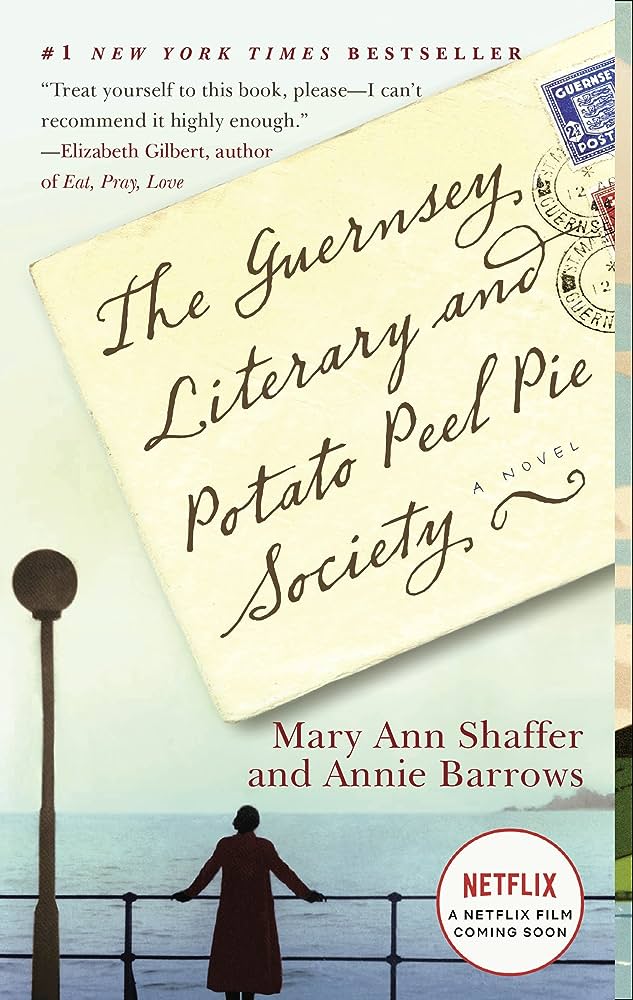
I do not prefer the epistolary form, and I am wary about having two authors on a book cover, as well, so The Guernsey Literary and Potato Peel Pie Society by Mary Ann Shaffer and Anne Barrows had two knocks against it from the beginning. But I had liked the movie. So one knock for. I ended up staying up late to finish the book, which meant I enjoyed the read. It wasn’t all that I hoped for (given the movie), but there were elements to the story being told in the book that were far better than the movie… then again, I had the movie to reference in my mind. If you are a romance reader, this one may fall a little flat, but if you are a historical fiction reader, this will probably be very interesting to you. Cute. Strong female protagonist. Like a Hallmark movie in book form, but much better. Definitely a book-lovers’ book, as well.
Juliet is emerging from a war-torn London and a bombed-out flat, post-WWII. She’s a writer on tour who is wary of her role as a humor writer. She receives a letter from the Isle of Guernsey requesting help to find a book by her favorite author, Charles Lamb, and Juliet begins corresponding with the mysterious Dawsey. She can’t help but be curious about the origin of his club, the Guernsey Literary and Potato Peel Pie Society, which had everything to do with the war, but—the reporter in her can tell—a different version of it. Just as one of America’s most eligible bachelors begins pursuing Juliet, she engages in a furious exchange of letters with Dawsey and the other members of the society and, with her quirky editor and BFF Sydney, uncover a real-life character who may just be her next, serious story. But first, she’ll have to go there and do some research…
This book does seem like something that would have at least crossed my radar in 2007 (and then the movie again in 2018), but it didn’t, that I recall. I missed the boat the first and second time around. The reason it came up now was that the movie showed up as a 99 percent match on some streaming channel I frequent and the title was intriguing and literature-related, so I watched it. As for the book, I didn’t realize there was a book, but I so enjoyed the movie I looked into it. Then, I was on a writing residency and it is part of my tradition to purchase an easy-read book at the local bookstore for nighttime reading. (Some of the books I have chosen in the past were The Song of Achilles and Book Lovers. Often, these books are not only easy reads (and romances), but also literature-related.) So I headed off to the bookstore where they not only still had multiple copies on hand (like 15 years later), but both of the booksellers behind the counter said, “I love that book!”
I was bummed when I saw that there were two authors. I don’t know. Why do I have that prejudice? In this case, it doesn’t really apply, anyway. The reason there are two authors listed is because the author fell ill after finding a publisher, and so got her niece to do the editing and rewrites during her illness and after her death. So the book is really written by Mary Ann Shaffer, but Annie Barrows (otherwise a children’s author) gets credit for fannying it up at the end. (It is also interesting that Shaffer had been wanting to write a “publishable” story for years, and had planned to write a biography of the wife of a polar explorer, which took her to England and, in a roundabout way, almost to Guernsey. Stuck in the airport, she read about the occupation there during WWII, and twenty years later, she had her historical novel in epistolary form.) Speaking of epistolary form, that was the main thing that bummed me out as I started reading. Epistolary novels strike me as choppy and as extra work for the reader. I and my ADHD don’t usually like them, but there are exceptions. After a handful of the letters in Guernsey, I riffled through the entire (short) book and was exasperated to find no exception to the epistolary form, even after Juliet must have gone to the island (which is where I kinda thought the letters would largely stop). But, despite myself, I was still enjoying the story and the characters, so I kept reading.
It was worth it. I don’t know that I would have condoned the epistolary form as, say, Shaffer’s editor. It does make the novel stand apart, a little. More importantly, it helps the reader get into the vibes of 1946, especially as someone in the writing and publishing world. People wrote snail mail letters back then, even telegrams, as a usual mode of communication. The world was small enough that they could be sent great distances relatively quickly, but phones were not as convenient as they are today. In that sense, epistolary makes sense for the history. Especially since that’s how Juliet gets to know the people of the Guernsey Literary and Potato Peel Pie Society. And how she first meet Dawsey. And not only is the history of the occupation on the island really interesting, but the slowness of the time (and lack of communication at all during the war) makes for superior plotting. (It is very difficult to create problems and stakes for characters when they all have smartphones in their pockets.)
I can’t go back and read the book first before watching the movie; what’s done is done. So it may be affecting my read (though I was kept guessing on the things that were changed, which are many). But I really liked the characters. Like really liked them. They were spunky, unique, and ultimately salt of the earth kind of people. (There were bad guys too. I didn’t like them.) The book is also big on confronting the complexity of humans and the gray spaces this leaves, especially in the particulars. On an island where the occupants were living in isolation alongside the occupied, strange relationships and understandings arose. There are moments of straight-up horror, as far as what happened to the Nazi’s prisoners of war and all those people (including Jews) who were rounded up to be used like disposable resources. There are also moments of human connection, compassion, bravery, etc. There is just a lot here, for such a small book. And the twists and turns and suspense will keep you (mostly) guessing. And it is well-written, with both clarity and sparkle.
And before I wrap it up, let’s take a look at Charles Lamb. Charles Lamb is the author whose book sets the main gears of the plot in motion. And he’s mentioned many times in the novel. I honestly didn’t even know whether or not he was real. He is. He was an English poet, essayist, and author who was contemporaries with Coleridge, Wordsworth, Shelley, Byron, etc. His Essays of Elia is actually on my original list of best books in the world, but I am nowhere near getting to it. Perhaps I should read it now that my curiosity is piqued by this book; it seems likely he has had a bit of a revival with Guernsey, since the characters are really into him. As a matter of fact, I think I will go ahead and read some collected prose and his (and his sister’s) Tales from Shakespeare.
So yes, a recommend. It’s a well-done, bright, interesting novel. It will give you something. It’s style and subject matter is perhaps not universally appealing, but for bookish types, those interested in history, or readers of romance, this is a real treat.
“Have you ever noticed that when your mind is awakened or drawn to someone new, that person’s name suddenly pops up everywhere you go? … He thinks that if one cares deeply about someone or something new one throws a kind of energy out into the world, and ‘fruitfulness’ is drawn in” (p116).
“As Seneca says, ‘Light griefs are loquacious, but the great are dumb” (p150).
“Sidney, in these past two or three years, I have become better at writing than living–and I think what you do to my writing” (p159).
“Writers ought to live far inland or next to the city dump, if they are ever to get any work done. Or perhaps they need to be stronger-minded than I am” (p165).
“Elizabeth was my friend, and in that place friendship was all that aided one to remain human” (p178).
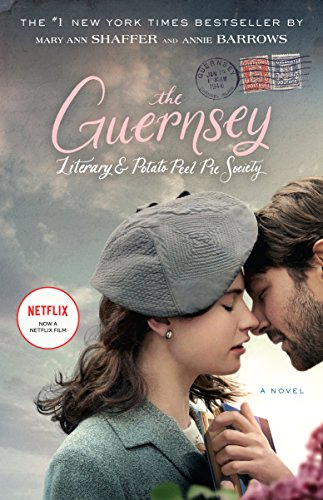
I saw the movie first. I didn’t even know if the book was supposed to be good, but Netflix tried to sell the movie to me because of my previous viewing habits or whatever; yeah, the computers know too much, don’t they? I was also on a writing residency and had discovered that I needed to end my laptop time hours before bed or flop around well after I turned off the light, so I made a line-up of writing- and book-related movies followed by some reading, to cap off the days. Making the movies (or shows) work-related made me feel marginally better about it, but I shouldn’t have felt guilty at all (and that’s another topic entirely).
I like romantic movies. I like some historical movies. This movie is a romance (which is kinda how it was sold to me), but it is also (even moreso) historical and is also a little literary and a little girl-power-y. I would definitely recommend it if anything about that appeals to you, especially if you are interested in WWII-era history (though like Number the Stars it is a slightly different angle on the war compared to what is usually presented). It is a well put-together movie with beautiful landscapes, quaint settings, even fun costuming, let alone a believable and sizzling romance, a mystery that unveils slowly, great acting, and interesting history. I only had one problem with the romance, and that was a complaint I often have—that we don’t see the romantic pair spending enough fun time together (which was the same with the book). We see a lot of awkward in this movie, and we see the attraction, but I’ll talk more about this topic in an upcoming blog. I also thought it was a nice movie for juxtaposing a transactional kind of relationship/marriage versus a more, shall we say spiritual one. And speaking of spiritual, I appreciated that the horrible, batty Christian lady was not foiled by a lovely, secular character but instead her grossness was attributed, basically, to misreading the Bible and not understanding the Christian faith at all. That was refreshing.
All in all, the movie was successful on several levels, including being very cute and interesting. Us literary-type females will especially relate to the main character and her 1940s nerdiness. And the writing part of the movie was okay, but not really a draw. What was particularly successful about this bit was using the writer/researcher as the jumping point for a story that begins by having absolutely nothing to do with her. I wondered how the author even decided that this was the voice to tell this story (looking into it later, I think the voice was close to the author herself and she could more easily see herself as the outside reporter lady), though I am a little tired of having writers play the hero in like half of every book out there. Juliet’s writing life was glamorized, for sure, and we all know I kinda hate that, but at least we get to see her struggle with what her story is and also what kind of life (and privacy) she wants for herself. The next morning, I woke up wondering if the book was any good and that is how we got where we are now. So, yeah, solid recommend, especially for a mixed audience.


 the starving artist