I have seen five movies in the past couple months which are related to books in one way or another. Since the Oscars are creeping up on us and two of the movies have Oscar noms, I thought I should go ahead and put my two cents out there for you.

The first—and arguably most important—of these movies is American Fiction. It is up for writing and acting Oscars as well as Best Picture. I don’t think it is likely to get Best Picture, but it definitely has my (nonexistent) vote (and I have seen most of the movies nominated in this category at this point). In other words, I love this movie. I had been looking forward to it and went to the theater to see it. I enjoyed it even more than I expected to. It is missing the over-the-top and quirky qualities of my favorite movies, but that’s not at all what it was aiming for and ended up being a seriously solid movie (with some quirk, I guess, a couple over-the-top moments).
American Fiction is based on the early 2000s book Erasure by Percival Everett. That this book was written two decades ago is startling when you see the movie, because the whole thing is social commentary and satire and it seems unbelievable that so little has changed since 2000. I do wonder how time-specific the book is compared to the movie remake, but I have not read the book. So I can’t say. Here are the themes of the movie: being a writer in a time when economics/sales drive the field; being a Black writer in a time when publication favors those who write to the stereotypes; forgiveness and loss and family; secretiveness/bottling as an unhealthy lifestyle and relationship-wrecker.
Monk is a Black writer and professor whose writing isn’t taken seriously because it isn’t what publishers expect of him as a Black writer. When he gets fed up with the system, he writes a ridiculously stereotyped novel about Black characters who are poor, fatherless, on drugs, violent and oppressed (and speak in heavy ghetto accent) as a joke. But when there’s a bidding war for the book followed by anonymous fame, Monk’s life becomes a dark comedy of situations and systemic racism. Meanwhile, his mother is suffering from dementia, the neighbor lady is making eyes at him, and his family is falling apart.
For once, a screenplay writer did a decent job of portraying the life of a writer, at least until Monk’s joke goes viral. I mean, many many writers have attempted to write to the market before, and it almost never—never?— ends with six-figure advances and prizes. But the point of this plotline is to make a point about the publishing world as well as being Black in America, and it does that. The acting is wonderful. There are great comedic moments. The plot works all the way through and is accompanied by jazz, an intentional soundtrack choice which feels different and fresh and important to the movie, even if you are not a jazz fan. Some wow moments. Probably my favorite movie of the year.

Then, a few weeks later, I went to see Argylle, another movie about a writer that I was looking forward to for just that reason. I mean, spy movies aren’t usually my thing, but this one featured a meta-story: Elly Conway writes spy novels and lives a quiet, maybe reclusive, life, considering her popularity. But when some random guy sits next to her on the train, claims to be a real-life spy, defends her life against several attackers, and basically kidnaps her to keep her safe, Elly isn’t at all sure where her books end and real life begins. (Note: the publicity material for this movie begs you not to spoil it after you’ve seen it. I was curious to see if I would guess the twist. Actually, it’s pretty good. The twists are, generally, surprises. So yeah, don’t tell.)
Argylle isn’t really on the same planet as American Fiction, but I also really liked this movie. It is absurdist, not in the content really, but in the presentation, and it is supposed to be overdone and, sometimes, laughably so. It plays with the genre stereotypes and ends up, in my opinion, playful. In the meantime, we get a number of good plot twists and a protagonist who is both amazing and looks like a normal woman.
For the record, this movie is not based on a book. The book, Argylle, that you see in bookstores is a gimmick. Go ahead and buy it and read it if you want. I believe it is a traditional spy novel, meant to be what Elly Conway wrote, but not to be the story that is portrayed as the plot of Argylle the movie. If you know what I mean. I don’t really need to read it, thanks.
There are many things the movie got wrong about being a writer and about the writing world, but as the movie progresses, you realize everything is supposed to be a cliché and man, this is a fun movie to watch. So no, bookstores never have huge spaces with vintage leather chairs and colorful banners for book readings and signings, but that is a place in the collective imagination, where all of the moments of this movie live. Maybe not my favorite movie of the entire year, but I liked watching it once and I would do it again, not even checking to see if other people liked it or not because, honestly, I think many people won’t understand the tone this movie is aiming for. Which is riotous and goofy. Loved it.

Shortly after, I took the plunge and saw Lisa Frankenstein, the title of which is a play on Frankenstein (the Mary Shelley book turned horror icon) and Lisa Frank (the colorful kids brand that used to be all over Trapper Keepers) as well as the name of our titular character. I am reluctant to see horror movies, but I will make an exception for campy stuff that I want to see for other reasons. I have seen most of the Frankenstein movies and I am a fan of the original book. I was also drawn to the 80s setting and the romance a la Warm Bodies.
Lisa is an outcast, because she’s new and weird, yeah, but also because she witnessed the brutal murder of her mother and is now dressing in black and hanging out at the cemetery. There is a particular headstone she likes to hang out at, so when the occupant of the grave reanimates he comes straight to her. Murder ensues. And love. And disastrous tragedy.
A play on movies from the 80s and so steeped in 80s references that I’m sure plenty of people were calling uncle (I wasn’t), this is another movie that is meant to be overdone, ridiculous at times. But it’s also funny. And uncomfortable (poking a finger into the side of the villain-as-hero genre). And has some great moments of both enjoyment and enjoyable cringe. Despite the dropping of one of the obvious threads and my scorn for the can’t-die-a-virgin concept, I ended up loving this movie, too. It had nothing to do with Frankenstein, or, a Modern Day Prometheus (the full title of the Shelley book), really, except to use some of the later references (mostly reanimation by electrocution), like from the movies as opposed to the book. Just like Argylle, if you can go into with modified expectations—in this case expecting a wild romp of campy violence, 80s teen movies, and macabre silliness—then you should have a good time. Especially if you’re 44.

Then as the Oscars approached and I had missed it at the theater, I rented The Color Purple to stream. We’re talking, of course, about the 2023 musical movie, not the 1985 movie or the book it was based on by Alice Walker. All of these things are titled The Color Purple, plain and simple. To be honest, I had wanted to see this one on the big screen because I suspected it would be best that way, that it would matter, and I was right. There is a lot of cinematic scope in this movie, including vocalizations that would be best appreciated when surrounded by them in high definition. Alas…
I know this is going to sound crazy, but out of these four movies, I was least impressed by The Color Purple. I mean, it might deserve an acting or costume Oscar, but overall it was a little disjointed and abrupt, uneven in its brilliance. Some of the scenes were, in fact, brilliant. Others were simply not. I wanted to connect to the story, but I felt a little confused about the themes, even. In the end, I think that this version of the story is about, as I saw it put, “Cely as a lesbian icon.” But considering that her growth as a character comes too-sudden and not-adequately-prompted (which could be said double for at least one other character) and the, I’m sorry, but sappy ending… I just couldn’t like this movie as a whole for the enjoyment of some of the parts. Nor for what it had to say, because it just didn’t come together. There is a better-edited version of this movie somewhere in a parallel universe, with just a few re-shot scenes to ease us into character growth. That’s the one that would do justice to the book and the earlier movie. (Note: I read that Alice Walker liked this adaptation. I don’t doubt it. There is a special voice that is caught here, as well as those really great moments.)
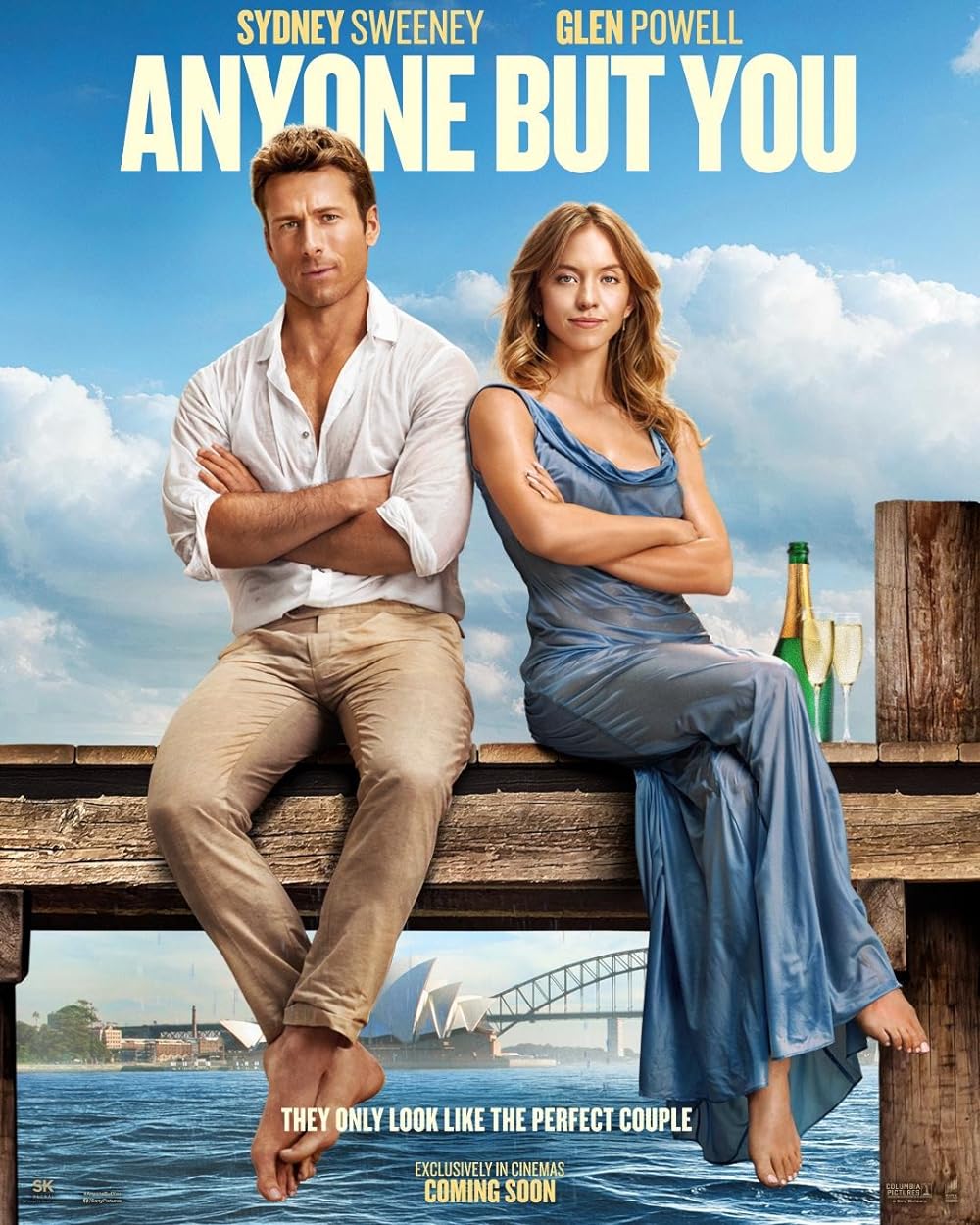
And then I was putting all this together and realized another movie belonged here. Go ahead and roll your eyes, I don’t care. But Anyone but You is based on literature, more directly in fact, than Lisa Frankenstein or even Argylle. You may not know it, but this classic rom-com is a retelling of Shakespeare’s Much Ado About Nothing. (In fact, there are quotes and references throughout the movie, to the point that it’s over the top in a maybe not great way.) And here’s the thing: I don’t think anyone was trying to be especially brilliant with this movie, and the acting is sometimes pretty horrible, but it is the best rom-com that has come to the theaters in ages. It’s funny. There’s sparks. There’s predictability (a staple of the genre). I was afraid this one was going to disappoint, but it totally didn’t. Lol-ed. Had a nice date night with my husband. Would definitely recommend and watch it again.
To conclude, all five of these movies are worth watching. It’s some of the best cinema of the year, for sure. If you’re okay with movies poking fun at themselves or being hyperbolic, especially, watching any one of these will be time well spent (as opposed to Madame Web. Please don’t see that instead).


 the starving artist